
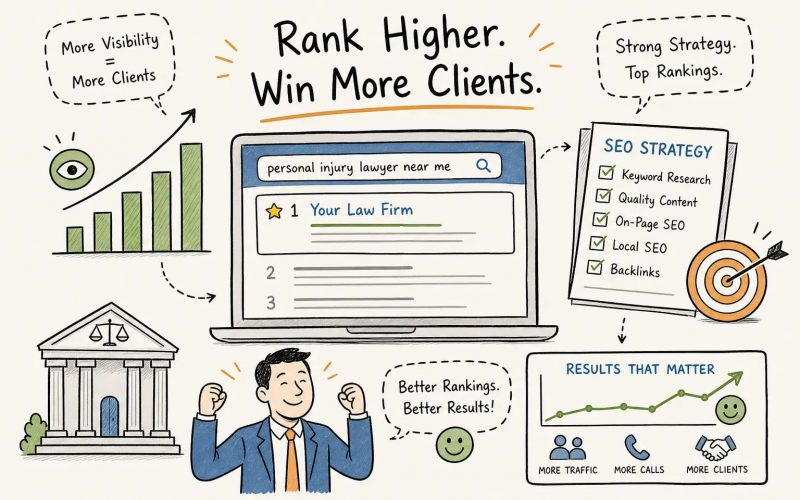
When someone searches “personal injury lawyer near me,” they’re not casually browsing, they’re close to making a hiring decision. Whether your firm shows up at that moment is the whole game. A well-built attorney SEO strategy gets your firm in front of those prospects before your competitors do, at the exact moment they’re ready to call.
At Thrive Business Marketing, we’ve worked exclusively in legal digital marketing long enough to recognize a consistent pattern: most attorneys who struggle with search visibility aren’t doing everything wrong, they’re doing it incomplete. They optimize one piece, maybe the homepage or a handful of blog posts, and leave three other pillars untouched. One gap is all a competitor needs to own the position you should hold.
This guide breaks down the five pillars of a complete law firm SEO strategy: keyword research, practice-area pages, local signals, authority building, and intake tracking. Each pillar connects to a measurable outcome, signed cases, not just traffic.
Keyword Research: Find Terms That Bring Cases, Not Just Clicks
The instinct for most firms is to target the biggest terms: “divorce lawyer,” “personal injury attorney,” “criminal defense lawyer.” Those terms pull hundreds of thousands of searches monthly, but they carry keyword difficulty scores in the 70s and 80s, meaning they’re dominated by national legal directories and major aggregators. A single-location firm won’t crack page one for “divorce lawyer” (KD 82) anytime soon, and chasing it burns resources that could be winning elsewhere.
The real opportunity in any attorney SEO strategy is local-modifier keywords. “Personal injury lawyer near me” is a high-volume term, but the local competition pool is smaller and more beatable than the broad head term. “Car accident lawyer near me” carries a KD of around 23 compared to roughly 53 for “car accident lawyer” on its own, figures that vary by tool and market but illustrate a consistent pattern across multiple keyword platforms. That gap matters enormously for how long it takes to rank and how much content authority you need to get there.
Build your keyword list around one primary term per practice-area page, with three to five supporting long-tail targets that capture question-based and location-specific searches. Start with the practice areas generating your highest-value cases, not the ones with the highest search volume. Google Keyword Planner gives solid demand signals; Ahrefs and Semrush provide the competitive picture you need to prioritize what you can realistically win.
Attorney SEO Strategy: Practice-Area Pages That Rank and Convert
Most law firm websites list every service on a single page or a vague “practice areas” overview. That structure works fine as a navigation aid but performs poorly as an SEO asset. Search engines reward specificity. A dedicated “car accident lawyer in [city]” page will consistently outperform a combined services page for that query because it matches intent precisely. This is a core principle of effective practice-area SEO.
The Hub-and-Cluster Structure Google Rewards
Build each practice area as a hub page, then surround it with related subpages and FAQ content that captures both commercial and informational queries. A “car accident lawyer” hub page links out to supporting content like “what to do after a car accident in [city],” “how long does a car accident claim take,” and city-specific subpages. This structure distributes authority across the site, signals topical depth to crawlers, keeps visitors engaged longer, and captures intent at multiple stages of the hiring decision.
Once you know which terms to target, the page structure you build around them determines whether that keyword research actually pays off.
What Every Practice-Area Page Must Include
Target 800 to 1,500 words as a baseline, with 1,500 to 2,500 words for highly competitive terms. Cover six core elements: the legal process, fees or cost expectations, timelines, case outcomes, attorney credentials, and a clear contact path. FAQ sections on practice-area pages are no longer optional; they directly feed “People also ask” boxes and AI answer engines that are increasingly part of how potential clients research attorneys before clicking anything.
E-E-A-T signals matter here too. Attorney bylines, bar admissions, visible credentials, and links to credible legal sources build the trust layer Google uses to evaluate legal content. These signals don’t just help rankings, they convert visitors who are vetting multiple firms simultaneously. A page that establishes authority and expertise closes more consultations than a page that simply lists services.
Attorney SEO Strategy: Local SEO and Google Business Profile
According to aggregated local SEO research, Google Business Profile signals account for roughly 32% of local pack ranking weight, with reviews contributing an estimated additional 20%, figures derived from industry ranking-factor studies and subject to variation by market and query type. For most law firms, local SEO for attorneys delivers the fastest visible results because GBP optimization is more controllable than building organic authority from scratch. This is where you can gain ground on competitors quickly.
Google Business Profile: The Settings That Move the Needle
Category selection is the single highest-leverage GBP setting. Choose the most specific category that accurately represents your practice, not the generic “Law Firm” option. Complete every profile section: service descriptions, hours, service areas, and photos. Add regular posts and respond to every question in the Q&A section. Proximity to the searcher is fixed, but relevance and prominence are within your control, and those two factors determine whether you appear in the local pack at all. This is one of the most underused levers in Google Business Profile for lawyers.
Reviews as a Ranking Signal and a Closing Tool
Reviews carry an estimated 20% of local pack weight, making them second only to GBP relevance in the local algorithm. Velocity and recency both matter: a firm generating consistent new reviews tends to outperform a firm with a large but stagnant review count. Generally, a firm with significantly more recent four- and five-star reviews will win more clicks than a competitor with far fewer, even when both appear in the top three map results, a pattern consistent with industry click-through research, though specific outcomes vary by market. Build a repeatable review-request process into your intake and post-case workflow, not a one-time campaign.
Building Authority Through Links and Citations
Links and citations account for roughly 14% of local pack weight and 31% of organic ranking weight, based on aggregated industry estimates. This is the pillar most law firms either skip entirely or handle through low-quality directory submissions that add noise without signal. Getting this right requires less volume than most attorneys assume and more relevance than most agencies deliver.
NAP Consistency and Legal Directory Citations
NAP stands for Name, Address, and Phone number. When these details appear inconsistently across directories, it creates conflicting signals that weaken local authority. Priority citation sources for attorneys include Avvo, FindLaw, Justia, Martindale-Hubbell, Super Lawyers, and local chamber directories. Managing listings across 200 or more directories represents the threshold most competitive practices need to maintain citation health, a volume that’s difficult to achieve or sustain manually without a dedicated system. Thrive Business Marketing handles this as a core part of its law firm SEO service, so nothing slips through without oversight.
Local Backlinks That Actually Move Rankings
One relevant local backlink outperforms ten generic directory submissions for organic rankings. State bar association member pages, local press mentions, community sponsorship links, and legal clinic partnerships at nearby universities are the highest-value local link sources. Use BrightLocal or Whitespark to audit your current citation health and identify specific gaps before running any outreach. Going in blind on link building wastes budget that could be spent on content that compounds over time.
Tracking Results: Connect SEO to Signed Cases
Rankings and traffic are inputs. What actually matters is whether those inputs produce consultations and signed retainers. Industry benchmarks put average law firm website conversion rates between 2% and 5%, with top performers reaching 8% to 12% or higher. Research consistently shows phone calls drive the majority of legal conversions, which means tracking call volume is non-negotiable, not a nice-to-have you add later.
The Metrics Worth Tracking Monthly
Report on organic sessions, keyword rank movement on your target terms, form submissions, tracked phone calls, and cost-per-lead from organic compared to paid channels. Keyword rankings tell you where you appear; conversion rate tells you whether the visit translates to anything. Both matter, but conversion rate is what determines whether your SEO investment is actually producing revenue.
Tools for a Complete Measurement Stack
Start with Google Search Console, it’s free and essential for any serious SEO effort. Add BrightLocal for local pack tracking and Ahrefs or Semrush for keyword tracking and competitive gap analysis. For content optimization, Surfer SEO and Clearscope benchmark your practice-area pages against what currently ranks. For multi-location firms, Local Falcon shows geo-grid ranking visibility, because rankings can shift dramatically block by block in dense metro markets.
Closing the Marketing-to-Intake Gap
SEO traffic only converts when your intake process captures it. A firm ranking first but running a slow or disconnected intake system loses cases it earned through search. Thrive’s CaseFlow System is designed to address this directly: it integrates marketing, intake automation, case management, and ROI tracking into one closed-loop system so firms can see precisely which SEO efforts generate signed cases, not just website visits. That’s the difference between knowing you rank and knowing your ranking is paying off.
Where to Go From Here
A complete law firm content strategy in 2026 is five pillars working together: the right keywords, structured practice-area pages, an optimized Google Business Profile, consistent authority signals, and tracking that connects visits to signed cases. Most firms doing one or two of these things reasonably well still struggle because the missing pieces create gaps the competition is happy to fill.
The firms that consistently win in search treat SEO as a system, not a task to check off quarterly. They build the structure, feed it with quality content, and measure results at the case level. That discipline separates the firms dominating local search from the ones wondering why their site isn’t producing leads.
If you want a clear-eyed assessment of where your current attorney SEO strategy has gaps and what to prioritize first, Thrive Business Marketing offers a no-obligation review. Our team specializes exclusively in legal digital marketing and knows precisely what moves the needle in competitive markets, and which tactics drain budget without generating signed clients. Reach out to get started.