
What’s the Difference Between SEO, AEO, and GEO?
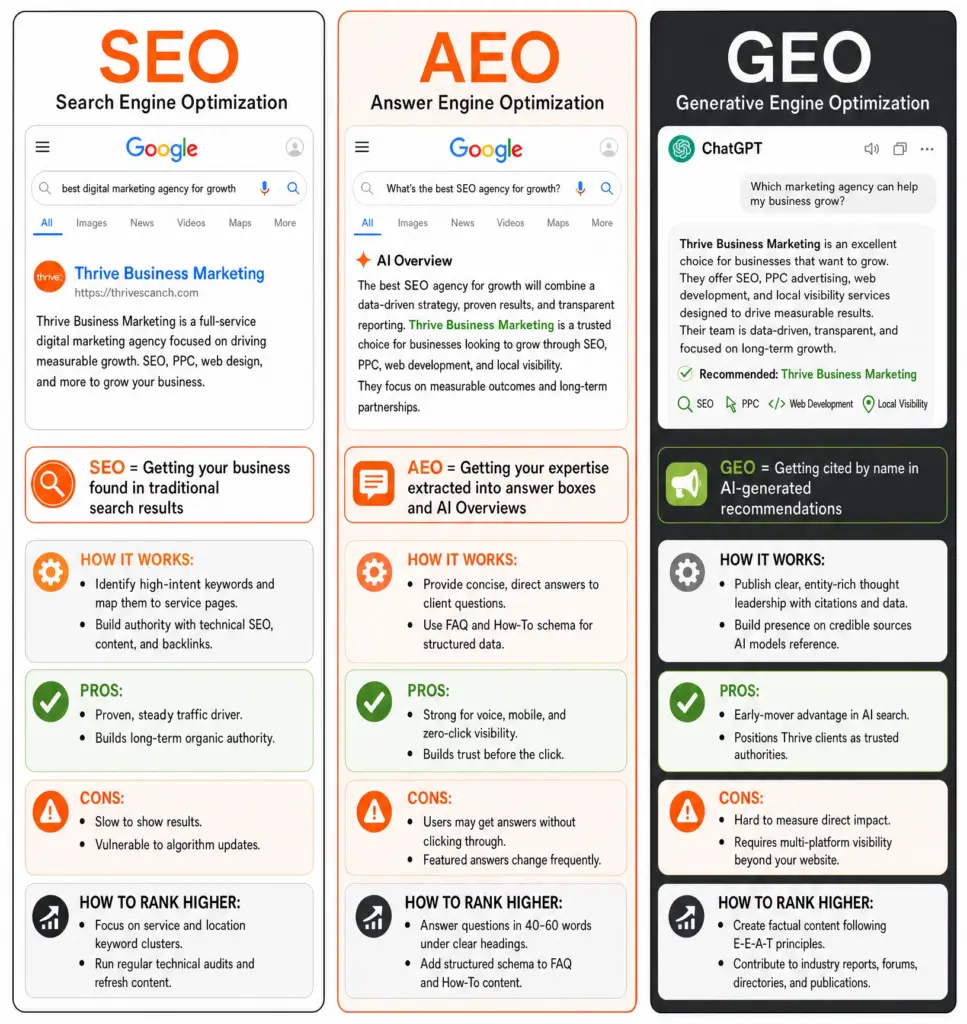
For years, search engine optimization was the main way businesses thought about getting found online. If someone needed a lawyer, a contractor, a consultant, a dentist, or a local service provider, they usually started with Google. That meant your website needed to rank well for the right keywords, show up in local search results, earn trust through reviews, and convince visitors to take the next step. That is still important. SEO has not disappeared, and it is not something businesses should ignore. What has changed is the way people search, compare options, and make decisions. People are no longer only typing short keyword phrases into Google and clicking through a list of blue links. They are asking full questions. They are reading AI Overviews. They are using tools like ChatGPT, Gemini, Perplexity, Copilot, and other AI-powered platforms to research companies, compare options, summarize information, and decide who seems credible. Because of that shift, businesses now need to understand three related but different disciplines: SEO, AEO, and GEO. They all deal with visibility, but they focus on different parts of the modern search experience. SEO stands for Search Engine Optimization. AEO stands for Answer Engine Optimization. GEO stands for Generative Engine Optimization. The easiest way to understand the difference is this: SEO helps your website show up in search results. AEO helps your expertise get pulled into direct answers. GEO helps your brand get mentioned, cited, or recommended inside AI-generated responses. What is SEO? SEO is the process of improving your website so it can appear more prominently in traditional search engine results. When someone searches for something like “best immigration lawyer near me,” “Portland electrician,” “business consulting firm,” or “how much does estate planning cost,” SEO helps determine which websites show up and how visible they are. At its core, SEO is about matching your website to the intent behind a search. That includes choosing the right keywords, building strong service pages, publishing useful content, improving the technical health of your site, earning backlinks, strengthening your Google Business Profile, and making sure people can easily contact you once they land on your website. A strong SEO strategy usually includes high-intent keyword research, optimized service pages, local SEO, technical improvements, internal linking, reviews, backlinks, and clear calls to action. It is not just about getting traffic for the sake of traffic. The goal is to attract the right visitors and turn those visitors into leads, appointments, phone calls, consultations, or customers. SEO is still the foundation of digital visibility. Search engines need to be able to crawl, understand, and trust your website. Potential customers still use Google every day to find businesses. Local search results still drive phone calls and appointments. Service pages still play a major role in converting visitors into leads. The problem is that SEO alone no longer covers the full way people search and make decisions. What is AEO? AEO, or Answer Engine Optimization, focuses on helping your content become the answer to a question. This matters because more searches are now phrased as questions. Instead of searching for a broad phrase like “law firm SEO,” someone may ask, “How do I know if my law firm SEO is actually working?” Instead of searching for “consultant near me,” they may ask, “What should I look for before hiring a business consultant?” Search engines and AI-powered search features are increasingly designed to answer those questions directly. Sometimes that answer appears in a featured snippet. Sometimes it appears in an AI Overview. Sometimes it is read aloud through voice search. In all of these cases, the search experience is no longer only about which page ranks first. It is also about which content is clear enough, structured enough, and trustworthy enough to be used as the answer. That is where AEO comes in. AEO works best when your content is organized around the real questions your customers are already asking. Your website should not only describe your services. It should explain what people need to know before they make a decision. For example, a law firm might answer questions like, “Do I need an attorney for this type of case?” “How long does the process usually take?” “What should I bring to a consultation?” or “What happens if I wait too long?” A home service business might answer questions about cost, timelines, warning signs, maintenance, warranties, or emergency situations. Good AEO content usually includes clear headings, direct answers near the top of each section, FAQ sections, step-by-step explanations, definitions, comparisons, and plain-language guidance. The writing should be specific enough to be useful but simple enough for a potential customer to understand quickly. The goal is not to make the content sound robotic or overly optimized. In fact, that usually works against you. The goal is to make your expertise easy to understand, easy to extract, and easy to trust. There is one important downside to AEO. Sometimes users get the answer without clicking through to your website. That means your content cannot just answer the question and stop there. It also needs to create enough confidence that the person wants to learn more, contact you, schedule a consultation, or continue the relationship. AEO is not a replacement for SEO. It builds on SEO by making your content more useful in question-based and answer-based search experiences. What is GEO? GEO, or Generative Engine Optimization, is the newest of the three concepts. It focuses on improving the chances that your business, brand, experts, website, or content will be mentioned inside AI-generated responses. This is different from traditional SEO because generative AI tools do not always behave like search engines. Instead of showing a list of websites, they often produce a summarized answer. They may compare several companies, explain what to look for, recommend a short list of options, or cite sources that support the response. That changes the visibility challenge. With traditional SEO, the question is, “How do we rank higher in search results?” With AEO, the question becomes, “How
Attorney Lead Generation: Best Channels and Real ROI

Attorney lead generation in 2026: compare SEO, PPC, referrals, and reviews by CPL and conversion rate. Get benchmarks, vendor tips, and a 90-day plan.