
7 Proven Ways Bankruptcy Lawyers Win Clients Online
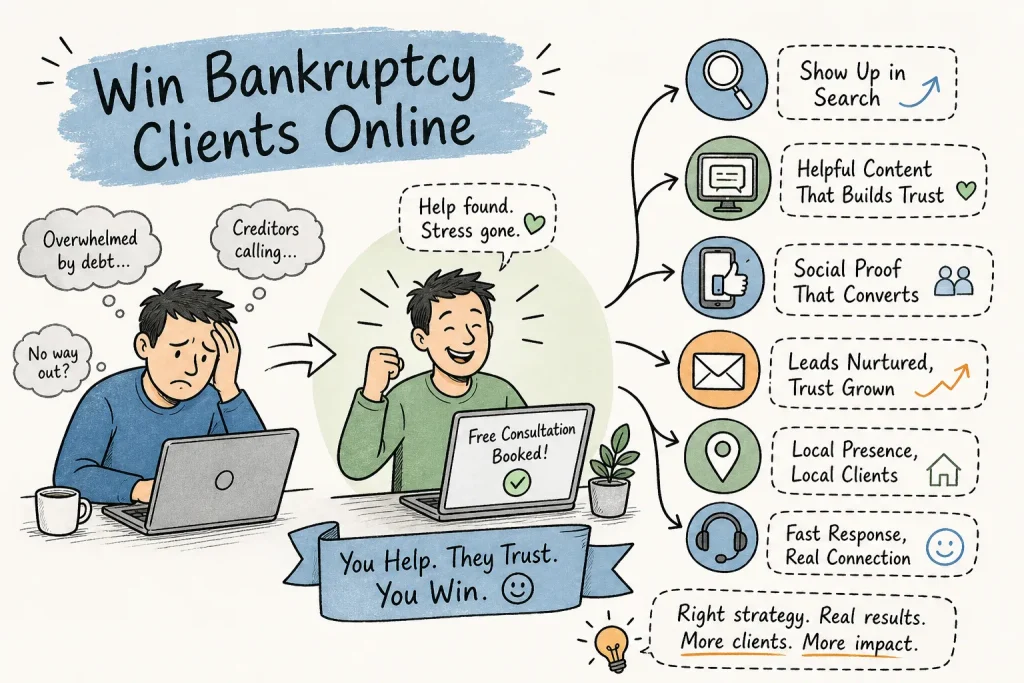
Discover how bankruptcy attorneys get clients online with 7 proven strategies: local SEO, Google Maps, PPC, reviews, referrals, and airtight intake systems.
SEJ Article Reaction: Google Search Console AI Reporting
Video Transcript: Original Article: https://www.searchenginejournal.com/google-tests-dedicated-ai-search-reports-in-search-console/577793/ Hey everyone, Scott Orth here. So I wanted to react to a recent Search Engine Journal article that caught my attention. It was about Google testing dedicated AI search reports in Search Console. And this is something I’m hoping to do more of now kind of when interesting or concerning news comes out in the industry to go ahead and hop on that and talk about it a little bit. So, if you’re a business owner, marketer, you know, SEO agency owner, or anyone who relies on Google traffic, this is a pretty big deal. Not because Google suddenly solved the, you know, entire AI search measurement problem. They definitely have not, but because this is one of the first real signs that Google understands website owners need more visibility into how their content is showing up in AI Overviews, AI Mode, and other generative search experiences. For the last couple of years, a lot of us in SEO have been asking the same question. How do we know if AI search is helping us, hurting us, or just changing the way people discover our content? And really, like this year, it’s more important than ever because AI is just everywhere. So, until now, the answer has mostly been, you know, we don’t really know. We can look at overall Search Console trends. We can look at organic clicks. We can look at impressions. We can look at traffic and analytics. But when AI Overviews and AI Mode are blended into the same reporting buckets as regular search, it becomes really hard to separate what’s actually happening. So according to the article, Google’s testing two things. First, a toggle in Search Console that lets website owners decide whether their site can appear in generative AI search features. Second, dedicated performance reporting that shows when URLs from your site appear in these AI-driven results. Google’s AI Search Visibility Toggle So let’s talk about the toggle first. This is interesting because Google’s basically saying you now have a choice. Your content can help ground AI responses and appear in AI features or you can opt out. But here’s the catch. If you opt out, Google says you won’t receive traffic or impressions from those generative AI features. So, for most businesses, especially small businesses, law firms, local service companies, and professional service firms, I don’t think opting out is going to be the move. In fact, I would think that would be quite the opposite of what you’d want to do. At least not right now. Why? Well, because even if AI search reduces some traditional clicks, it’s also becoming part of the discovery journey. So, people are asking longer more detailed questions. They’re comparing options. They’re researching services. They’re asking for recommendations, summaries, explanations, things of that nature, and then kind of moving into like next steps. They’re not just searching for a keyword. That means your business needs to be eligible to show in those moments. So if you remove yourself from that environment, you may be protecting your content kind of in one sense, but you may also be removing your brand from where search behavior is clearly heading and where your audience actually is doing their searching. Now I do understand why publishers and content heavy sites are concerned. If Google uses your content to answer the question directly and the user never clicks through, that’s a real issue. I mean, it impacts traffic, attribution, ad revenue, and lead flow and so forth. So, I get it. But for any kind of service business, I’d be very cautious about opting out of visibility. The better place is to understand how you’re showing up, strengthen your authority, and create the type of content AI systems are likely to reference. What Google’s AI Search Reports Could Show All right, so now let’s talk about reporting. This is the part I think I’m most interested in. Google’s new AI search reports are expected to show impressions from generative AI features. The article says the reporting can be broken down by page, country, device, and date with hourly level detail. So, that could really be useful. It tells you which pages are being surfaced inside AI experiences. It gives you some directional insight into whether your content’s being recognized as useful enough to appear in AI-generated responses. Why Impressions Alone Aren’t Enough But here’s my honest reaction. Impressions alone, they’re just not enough. They’re helpful, but they don’t answer the bigger business question, right? The real question is not just did my page appear. We want to know, did that appearance drive any meaningful action? Did someone click? Did they visit the site or did they call? Did they fill out a form or book a consultation? Right? Did they become a lead or a customer? That’s what we really want to know. And that is currently or even with this new update, it’s the reporting gap. According to the article, Google’s dedicated reports do not yet include click data or query level metrics for AI search. So that’s a major missing piece. I mean, because without click data, marketers and business owners are still left trying to connect the dots. For example, imagine you see that your service page appeared 5,000 times in AI Overviews. That sounds great, but what if it drove zero clicks? What if it drove fewer clicks than before, and those who did click weren’t really qualified or what if it showed up for the wrong topics entirely? Right? Without query level data and click data, you can’t fully evaluate performance. You can only see visibility. And that’s, you know, with typical SEO, with paid ads, everything else, that’s what we’re looking for. We’re looking for what was the search query that brought somebody to a website and then what did they do when they were there. That whole journey is critically important to marketing, not just, you know, how many