
Why Top Law Firms Aren’t Scared of the Traffic Drop

Law practices nationwide are seeing an organic traffic drop law firms once considered impossible after years of relying on a predictable search engine playbook. Major search engine algorithm changes legal engineers rolled out have effectively broken the old content model, leaving legal marketers and managing partners watching their legal prospective client pipeline shrink overnight. Where legacy firms see a crisis, market leaders see clarity. Forward-thinking firms remain calm because they are replacing high-volume keyword chasing with robust law firm online authority building that captures high-value legal cases regardless of search volatility. The shift isn’t about working harder to regain lost visitors; it is about recognizing that high-volume traffic was always a proxy metric, not a revenue engine. Modern client acquisition requires a fundamental reimagining of how law firms present expertise, capture intent, and evaluate marketing performance. The Broken SEO “Vending Machine” For over a decade, law firms spent years treating organic search like a simple automated transaction where cash went in and signed retainers came out. Partners routinely funneled budget into high-volume, low-intent legal content—such as generic explainer posts on “What to do after a fender bender”—expecting a steady, predictable stream of signed personal injury, family law, and estate planning cases. Recent AI search updates legal industry leaders faced broke that direct intake funnel entirely. Generative search interfaces now summarize basic legal principles directly on the results page, stripping away the informational clicks that used to pad organic reporting spreadsheets. Key factors driving this fundamental disruption include: Eliminating Content Library Waste As broad traffic declines, law firms face rising expenses associated with hosting, updating, and managing bloated digital article libraries. High-volume, low-quality content strategies that once dominated attorney search engine optimization now create drag on site performance, dilute domain authority, and waste technical resources. A firm maintaining 2,000 generic blog posts is often paying to index hundreds of pages that have not generated a single lead in years. Forward-thinking marketing directors follow a structured framework to clean up bloated legal websites and realign their digital footprint with genuine business outcomes. Matrix Phase Content Library Action Target Metric Expected Firm Outcome 1. Identify Waste Flag generic articles suffering severe traffic drops Attorney website organic traffic Uncover pages draining site crawling efficiency 2. Prune Thin Pages Remove or redirect low-value legal posts Managing partner SEO metrics Direct search engine focus to high-value pages 3. Consolidate Assets Merge overlapping articles into definitive guides Law firm content ROI Elevate overall domain authority on key topics 4. Multi-Channel Reuse Convert blog text into direct client materials Legal marketing case consultations Engage prospects directly via non-search channels Cleaning up a digital library requires surgical precision rather than wholesale deletion. When pruning thin content, legal marketing teams must carefully evaluate historical backlink profiles. Merging three average posts on commercial truck accident liability into one authoritative, long-form resource preserves earned link equity while signaling deep topical mastery to both search engines and prospective clients. Fixing the Boardroom Reporting Crisis Tension builds between managing partners and marketing directors when reporting sessions focus on outdated web metrics. Historical reporting models treat raw traffic as the primary indicator of growth, leading partners to misinterpret lower site visits as business failure—even when signed cases and revenue remain stable or grow. When marketing teams present slides celebrating 50,000 monthly visitors, but the firm’s legal case intake strategy yields fewer retained clients, executive confidence erodes. Modern firms bridge this gap by replacing vanity metrics with clear revenue-attribution models. Modern Legal Marketing Metrics Hierarchy How Leading Law Firms Win Today Elite legal practices adapt to ongoing algorithm shifts by building authentic brand authority instead of relying on outdated traffic tactics. These top firms focus heavily on direct client relationships, referral networks, and distinctive attorney expertise. They consistently capture high-value legal cases marketing opportunities by demonstrating genuine trial experience rather than chasing raw click volume. To establish unshakeable authority in a zero-click search environment, top-tier firms implement four core operational changes: Future-Proofing Your Law Firm Client Acquisition An organic traffic drop law firms experience today marks a necessary evolution toward higher marketing efficiency rather than a business crisis. Filtering out casual web searchers allows legal marketing teams to stop chasing law firm web traffic and concentrate resources on attracting high-value legal cases marketing leads. Managing partners who measure growth through actual case revenue and signed retainers build resilient practices that withstand search engine algorithm changes legal engineers roll out. Modern success requires shifting focus from high-volume keyword chasing toward building genuine law firm brand authority, executing a legal content library audit, and optimizing direct case intake channels. Partnering with the legal digital marketing specialists at Thrive Search helps your practice adapt its client acquisition strategy, build authentic online authority, and secure qualified legal consultations in a modern search environment.
Managing Your Website’s Language & Currency Settings For a Global Audience

When an prospective client from London, Toronto, or Sydney lands on your law firm’s website, what do they see? If your site automatically defaults to U.S. dollars, local state legal terminology, or forced language redirects, you might be losing valuable international retainers before they even reach your contact form. Cross-border legal inquiries—ranging from international commercial contracts and cross-border estate planning to global IP protection—are on the rise. However, capturing this global traffic requires more than installing a auto-translation plugin. You need a intentional international search strategy that serves localized content, handles multiple currencies gracefully, and signals exact regional targeting to search engines. If you are seeing international visitors in your analytics but are not sure how to structure your domain, configure hreflang tags, or handle currency displays, this guide walks through the exact framework your law firm needs. How should a law firm structure URL directories for international website visitors? The best site architecture for most law firms expanding globally is using subdirectories (also known as subfolders, such as [yourfirm.com/uk/](https://yourfirm.com/uk/) or [yourfirm.com/ca/](https://yourfirm.com/ca/)) on a single primary domain. This approach keeps all of your domain authority, backlink profile, and SEO strength consolidated under one domain while giving search engines clean, segmented paths for each country or language. When setting up a site for multiple regions, legal practices typically choose between three main URL structures: Google’s Search Central documentation explicitly notes that subdirectories offer the lowest technical overhead while consolidating domain metrics across all localized versions. For law firms offering cross-border services, using subdirectories like [yourfirm.com/en-gb/](https://yourfirm.com/en-gb/) ensures your localized pages benefit from your main domain’s existing search credibility. How do hreflang tags tell Google which version of a law firm page to display? hreflang attributes are HTML code elements that explicitly tell search engines which language and country a specific page is built for. They ensure that a user searching from London gets served your [yourfirm.com/en-gb/](https://yourfirm.com/en-gb/) page, while a user in New York sees [yourfirm.com/en-us/](https://yourfirm.com/en-us/). HTML Without hreflang tags, search engines may view your regional pages as duplicate content because the text on your UK page might be 90% identical to your US page. According to Google Search Central’s localized page guidelines, three critical rules govern hreflang implementation: What is the right way to handle foreign currency and legal fee disclosures on a law firm website? Law firms should display billing rates or retainers in the local currency using transparent dynamic selection or manual toggle switches, paired with clear disclaimers detailing fee structure regulations and exchange rate policies. Never use forced IP auto-redirects that trap international users or prevent search engines from crawling your default content. Handling currencies and legal fees for global clients introduces both technical user experience challenges and professional conduct requirements: What steps should a law firm take to roll out an international SEO setup? Frequently Asked Questions Citation References & Sources
Law firm paid search: How it works and what it costs
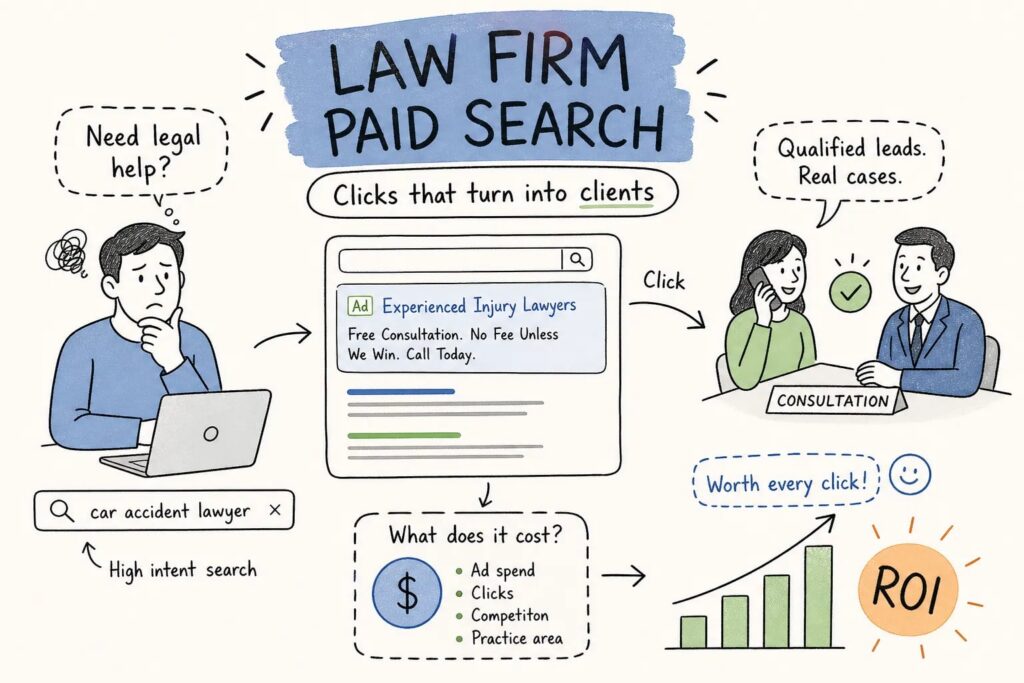
Law firm paid search works differently than most industries. Learn how legal PPC is priced, structured, and measured — and how to run compliant, high-ROI campaigns.