
Immigration Law Leads: The Channels That Actually Convert

Want more immigration law leads? Discover which channels deliver the best ROI, from local SEO to Google Ads, and how to turn inquiries into signed clients.
How to Attract Immigration Clients Through Local SEO

Attract more immigration clients through local SEO: optimize your Google Business Profile, build citations, earn multilingual reviews, and rank in the local map pack.
Immigration Attorney SEO: How to Choose the Right Agency
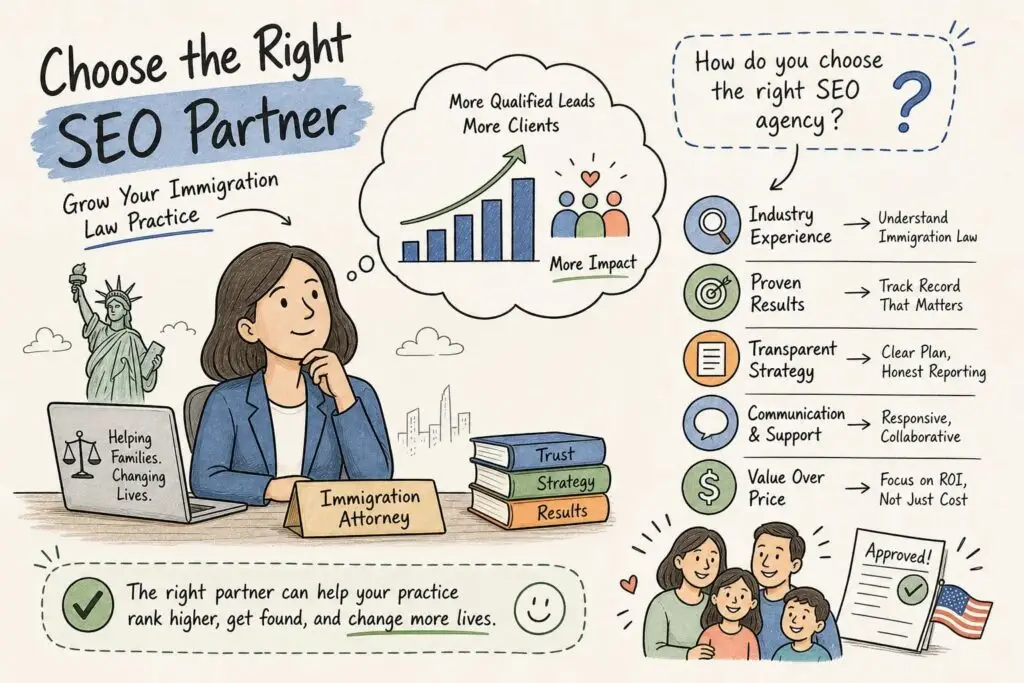
Not every SEO agency understands immigration law. Learn what immigration attorney SEO should cover, what results to expect, and how to find the right partner.
Immigration Lawyer Marketing: Attract Urgent Clients Online

Immigration lawyer marketing built on local SEO, Google Maps, multilingual content, and reviews fills your pipeline fast. See the full strategy here.
Criminal Law Ads: How to Run Campaigns That Get Real Clients

When running criminal law ads, the channels that consistently sign criminal defense clients are Google Search and Local Services Ads for urgent-intent searchers, supported by social retargeting as a secondary layer. The targeting principle that separates profitable campaigns from money-wasting ones is charge-specific plus local: separate campaigns for DUI, drug possession, felony, and domestic violence, each paired with the city or county where the firm actually takes cases. The copy formula that converts is availability plus specific charge plus location plus a phone call to action, and documented attorney marketing campaigns have proven it repeatedly. Every campaign must also stay within ABA Rules 7.1 through 7.5 and the state-specific rules that layer on top, because a high-performing headline can become a bar complaint if it crosses the line on outcome guarantees or specialist claims. Criminal defense advertising is uniquely high-stakes, clients are searching in crisis mode at 2 a.m., competition in major metros drives CPCs to $120–$280 for DUI and felony terms, and the difference between a compliant ad and a problematic one can be a single phrase. Firms that partner with legal-specialized advertising agencies often outperform those using generalist agencies because the targeting, messaging, and intake systems are built around how criminal defense clients actually search, decide, and hire. By the end of this article, you will know exactly how to structure campaigns, write copy, set realistic budgets, and stay compliant. Key takeaways Google Ads vs. social: which channel actually delivers criminal defense clients? Why Google Search and Local Services Ads dominate urgent criminal matters Criminal defense has one of the clearest purchase-intent signals in legal advertising. Someone searching “DUI lawyer near me at 2am” is not researching options for next month, they need help right now, and Google Search captures that moment directly. Liberty Criminal Defense, for example, attributed a 5x increase in DUI cases directly to a focused paid search strategy. Local Services Ads amplify that advantage further by appearing above standard ads with Google’s verification badge, which matters significantly when a prospective client is making a trust decision under pressure. LSAs charge per valid lead rather than per click, which changes the economics considerably. You pay when someone contacts your firm, not when they skim your headline and move on. That structure, combined with prominent placement and social proof from reviews, makes LSAs the natural starting point for any criminal defense paid campaign. Where social ads earn their place in the campaign mix Meta platforms are not where you find someone actively searching for a defense attorney. Users scrolling Facebook are not in crisis mode, so cold criminal defense lead generation through social rarely produces the lead quality that justifies the spend. Social earns its budget allocation in a different role: retargeting website visitors who did not call, reaching family members who may hire counsel on someone else’s behalf, and building local brand recognition at controlled cost. Social CPMs in the $15–$50 range can make awareness at scale more cost-efficient than the effective CPM implied by high search CPCs in competitive legal markets, though Google Search remains the priority for direct lead generation. Channel-by-channel comparison: cost, intent, and best use case Channel Typical CPC / CPM Typical Cost Per Lead Intent Level Best Use Case Google Search $40–$150 CPC (major metro: $120–$280 for DUI/felony) $100–$300; up to $400+ for premium markets High Charge-specific, urgent-intent searchers Google Local Services Ads Pay per lead, not per click Varies by market; often competitive with Search Very high Local “lawyer near me” and contact-ready searches Meta (Facebook/Instagram) $1–$15 CPC; $15–$50 CPM $25–$100 for lower-intent leads; $75–$200+ for qualified inquiries Low to medium Retargeting, family-member audiences, brand awareness YouTube / Video CPM-based; varies widely Difficult to attribute directly Low Trust-building and awareness before search How do you target urgent-intent criminal defense searchers? Charge-specific keyword campaigns that outperform generic searches “Criminal defense attorney” as a standalone keyword is expensive and pulls in a wide range of searchers, many of whom are not ready to hire. The better approach is separate campaigns for each charge type: “DUI lawyer [city],” “drug possession attorney [county],” “domestic violence defense lawyer [city],” and “felony lawyer near me.” Charge-specific targeting produces meaningfully lower cost per lead than generic campaigns because the ad, the keyword, and the landing page all align with what the searcher actually needs. Use exact and phrase match as your primary approach, and treat negative keywords as a budget-protection tool: exclude “public defender,” “law school,” “jobs,” “bail bondsman,” and research-intent terms from day one. Geotargeting, device strategy, and timing your bids Start with the counties and court jurisdictions your firm actually serves, not a fixed mile radius drawn around your office. Test 10-, 25-, and 50-mile radii, then shift budget toward the geographic areas producing retained clients rather than raw form fills. Mobile dominates urgent criminal defense searches: someone arrested on a Friday night is searching on their phone, not on their laptop. Set bid adjustments that favor mobile traffic, and apply evening and weekend multipliers for DUI and immediate-arrest campaigns where demand spikes outside business hours. Retargeting and audience segments that convert more reliably First-party retargeting audiences consistently convert better than cold traffic because the prospect already expressed interest in your firm. Build audiences from recent website visitors, landing-page visitors who did not call, incomplete lead-form openers, and video viewers. On Meta, build lookalike audiences from retained clients rather than every form submission you received. That distinction matters: a lookalike built from qualified, signed clients finds people who resemble your best cases, not people who clicked once and disappeared. What ad copy and messaging actually drives criminal defense inquiries? Headlines that mirror the searcher’s immediate situation The best criminal defense headlines connect the searcher’s specific charge, location, and emotional state to an immediate solution. In a documented case study, a Cherry Hill, New Jersey criminal defense firm reduced its cost per lead from $787 to $11.80 after shifting from vague “experienced lawyer” messaging to availability-first headlines. “Available 24/7” and “Speak to an attorney