
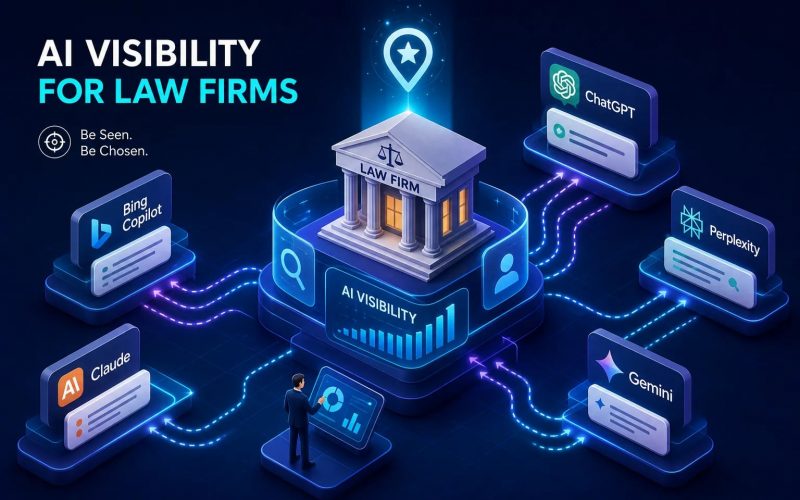
Law firm brand visibility in AI tools is no longer a future concern, it’s actively determining which attorney a potential client calls after a car accident, a DUI arrest, or a custody dispute. Potential clients aren’t just typing queries into Google anymore. They’re asking ChatGPT who to call after a car accident. They’re asking Perplexity to recommend a criminal defense attorney in their city. And they’re trusting the answer they get. Data from Grow Law shows that 72% of their law firm clients now appear in Google AI Overviews, while 28% are directly mentioned in conversational AI responses from ChatGPT, Gemini, and Perplexity. The firms showing up aren’t there by accident.
They’ve built the right signals, and that’s exactly what this guide breaks down. You’ll learn how AI tools decide which law firms to surface, which on-site and off-site factors drive citations, how to measure your generative-AI search visibility with real formulas, and how to run a 90-day plan to close the gap. At Thrive Business Marketing, we’ve tracked these patterns across dozens of law firm clients nationwide, and the playbook is clearer than most attorneys realize.
How AI tools decide which law firms to surface
Many attorneys assume AI works like a smarter Google search. It doesn’t, and that misunderstanding leads to the wrong strategy. ChatGPT and Gemini are general-purpose language models: when someone asks a legal question, they generate answers from training data and pattern prediction, not from a live legal database. They surface plausible answers by drawing on learned associations rather than retrieving live results. Perplexity is more source-forward, designed to retrieve and cite links, and it can be extended with connectors that surface primary legal sources. This distinction is central to any answer engine optimization (AEO) strategy for law firms.
For your visibility strategy, that distinction matters. On ChatGPT and Gemini, your firm’s training-data footprint is a major factor in whether you get cited, alongside recency, on-site content quality, and third-party mentions. On Perplexity, your indexed presence across directories, publications, and your own site plays a larger role. You need both angles covered, not just one.
Entity clarity: what it is and why AI needs it to cite your firm
Before any AI model cites your firm, it needs to recognize you as a distinct entity. Entity clarity means your firm’s name, URL, description, location, practice areas, and contact details are consistent and unambiguous across every source an AI might encounter. That includes your website, directory profiles, press mentions, and Google Business Profile. Fragmented or inconsistent signals get passed over, even when a firm dominates locally in traditional search rankings.
Think of it this way: if your firm appears as “Johnson Law” on your website, “Johnson Law Firm LLC” on Avvo, and “The Johnson Group” on Yelp, AI models see three different entities. They don’t resolve the conflict in your favor. They skip to the next result. This is why JSON-LD Organization schema on your homepage should include your firm name exactly as your canonical entity name, with sameAs links pointing to every major directory profile.
Why brand recognition in training data creates a compounding advantage
The more your firm appears across trusted sources, legal publications, directories, bar association sites, and local news, the more training data associates your firm with specific practice areas and locations. Observational analyses from vendors including Grow Law and Semrush indicate that brand mention frequency is among the strongest predictors of AI citation likelihood. This creates a compounding effect: visibility generates more visibility. Smaller firms can still compete, but only by concentrating their presence in the right places rather than spreading thin.
On-site signals that make your firm citation-worthy
Once AI knows your firm exists, the next question is whether your website gives it anything worth citing. Many law firm sites lack the Q&A-style content and FAQ markup that observational analyses show are essential for AI citation. Generic practice area pages, thin attorney bios, and promotional homepage copy don’t match the question-and-answer format AI tools use to generate responses.
The schema types that matter most for legal AI citations
FAQPage schema is commonly observed as a high-impact citation driver in vendor and observational analyses, because it directly mirrors the question-and-answer format AI tools extract from. While controlled causal evidence is still limited, FAQPage markup consistently appears in practitioner case studies as a top structural signal. Article and BlogPosting schema add authorship and publication dates, which signal editorial credibility. Organization schema on your homepage anchors your firm’s entity identity across the web, and when implemented as JSON-LD, it should include your firm name exactly as the canonical entity to maximize entity clarity for AI systems.
The practical implementation looks like this: every practice area page should carry FAQPage markup, your homepage should carry Organization schema with sameAs links pointing to your directory profiles, and every published legal article should use Article schema with author attribution. These aren’t optional extras. They’re the structural layer that makes your content machine-readable to AI systems.
Content formats AI engines extract from most reliably
Plain-English guides, case-type explainers, local practice area pages, and Q&A content pages are the formats AI pulls from most often. Conversational, specific content that answers real intake questions outperforms broad promotional copy consistently. A page titled “What to expect after a DUI arrest in [city]” earns AI citations more reliably than a generic criminal defense homepage. Depth and specificity matter more than volume.
Attorney bio pages are also citation triggers when they include credentials, bar admissions, case types handled, and links to authored articles. Practice area pages that cover jurisdiction-specific information, common client questions, and case outcome examples build the semantic authority AI needs to surface your firm for local legal queries. This content infrastructure, structured signals built without requiring attorneys to manage it manually, is exactly what Thrive Business Marketing incorporates into its legal AI SEO framework.
Off-site authority and the legal directory advantage
On-site signals alone won’t get your firm cited consistently. AI tools don’t just crawl your website. They pull from the full ecosystem of sources where your firm appears: directories, publications, reviews, and third-party mentions. In a February 2026 sample of 200 legal AI answers, Avvo appeared 60 times, Martindale-Hubbell 41 times, Super Lawyers 37 times, and Justia 17 times. Your directory presence isn’t a nice-to-have. It’s a core citation signal.
Why legal directories carry outsized weight in AI answers
Legal directories act as citation amplifiers because they package structured, third-party validation that AI systems retrieve easily. ChatGPT draws heavily on internet consensus, including well-indexed directory profiles. Complete, accurate, and active profiles on Avvo, Justia, Best Lawyers, Super Lawyers, and similar platforms increase the probability that your firm appears when AI assembles a legal recommendation. Incomplete profiles, or profiles with mismatched firm names and addresses, actively reduce your citation share.
Earned media and third-party mentions as citation amplifiers
Third-party mentions carry disproportionate weight in AI answers because they signal that independent sources consider your firm credible. Building brand authority for AI requires a consistent outreach strategy. Guest commentary in legal publications, bar association contributions, podcast appearances, and local news features all build this signal. Quantity matters less than source authority: one citation in a state bar journal outweighs ten citations in low-authority directories. Target legal media, professional associations, and community organizations for the highest return on outreach effort.
How smaller firms compete for AI citation share
Large firms dominate AI citation share partly because they appear more frequently in the sources AI already trusts. But smaller firms can compete on specificity. Targeting long-tail, intent-rich queries such as “what happens if I miss a court date in [city]” or “best immigration attorney for DACA renewal in [county]” allows a niche firm to outperform national brands on queries where hyper-local relevance matters more than raw brand size. Consistent directory coverage across a broad range of high-value platforms, vendor best practices typically recommend 200 or more, combined with practice-area-specific content, closes more of this gap than any single tactic can.
Metrics to measure law firm brand visibility in AI tools
Most law firms have no system for measuring their AI visibility. They want to show up in ChatGPT but have no baseline, no tracking process, and no way to know if their tactics are working. These four metrics give you a complete picture without requiring enterprise-level tooling to get started.
Citation rate, citation share, query coverage, and AI share of voice
Citation rate measures how often your firm appears across a defined set of tracked prompts: (prompts where your firm is cited ÷ total tracked prompts) × 100. A firm with a 40% citation rate appears in 4 out of 10 AI answers for its tracked queries.
Citation share shows how much of the AI citation “pie” you own relative to competitors: (your firm’s citations ÷ total citations across your competitor set) × 100.
Query coverage measures breadth across practice areas and locations: (target prompts where your firm appears ÷ total target prompts) × 100.
AI Share of Voice provides a clean competitive benchmark: (your mentions ÷ your mentions plus competitor mentions) × 100. Together, these four metrics track zero-click AI impressions and give you a defensible, repeatable view of your firm’s generative-AI search visibility over time.
Tracking with Google Search Console, GA4, and manual prompt testing
In Google Search Console, open Performance, go to the Queries tab, and filter for queries at positions 1, 9 with near-zero clicks. Group those by practice area, then manually test them in AI tools to see if your firm appears. These are your AI Overview candidate queries. In GA4, watch for branded organic search lift and referral traffic from known AI domains after you make visibility changes. Both signals help you connect AI citation gains to actual business impact.
For manual prompt testing, build a set of 15, 20 real client intake questions by practice area. Test them monthly across ChatGPT, Gemini, and Perplexity. Record whether your firm is named, whether your site is cited, your order among results, and which competitors appear. This is still the most transparent measurement method because it shows exactly what a prospective client would see.
Third-party tools worth knowing
Tools like Semrush AI Visibility Toolkit, Ahrefs Brand Radar, Otterly.AI, and Peec AI automate recurring prompt tests and compare citation frequency against a defined competitor set across ChatGPT, Gemini, and Perplexity. For a law firm just starting out, even a simple tracking spreadsheet, with columns for prompt, engine, date, firm cited (yes/no), position, and competitors mentioned, is enough to establish a baseline and measure month-over-month progress. Start there before investing in a paid platform.
A 90-day action plan to build AI citation authority
Knowing the signals is one thing. Building them systematically is another. This phased plan prioritizes high-impact actions first and builds momentum as the infrastructure takes shape.
Days 1, 30: fix the foundation
- Audit and implement Organization schema on your homepage with complete sameAs links pointing to your directory profiles, using your firm’s canonical name in JSON-LD.
- Add FAQPage schema to all practice area pages.
- Audit your firm’s name, address, phone number, and URL across all directory profiles and correct any inconsistencies.
- Claim and complete profiles on the top legal directories.
- Set up your prompt-tracking spreadsheet and run a baseline test across 15 queries.
This entire phase is about making your firm’s entity clear and consistent to any AI system that encounters it.
Days 31, 60: build content and expand directory presence
- Publish at least four practice area explainers or FAQ pages in conversational, specific format targeting real client questions.
- Optimize attorney bios with credentials, authored content links, and jurisdiction details.
- Submit or update profiles to a broad set of high-value directories, 200 or more, using a local listings management tool.
- Pitch one guest article or commentary piece to a legal publication or bar association outlet.
- Run your second prompt test and compare results to your day-one baseline.
Days 61, 90: test, track, and close competitor gaps
- Analyze your citation rate, citation share, and query coverage metrics from the first two rounds of prompt testing.
- Identify competitor gaps: the queries where competing firms appear in AI answers but yours does not.
- Create content that directly addresses those query gaps.
- Evaluate which AI platforms cite your firm most and least, and adjust your off-site strategy toward the weaker platforms.
By day 90, you should have a clear trend line emerging and a repeatable monthly tracking process in place. Results will vary by market, starting visibility, and available resources, but most firms working this plan consistently see measurable movement in citation rate within the first two cycles of prompt testing.
Thrive Business Marketing builds this infrastructure as a managed system, integrating it with intake tracking and ROI reporting. That means nothing falls through the cracks between visibility gains and actual case inquiries, which is where most law firms lose value when they try to manage this in-house.
The gap is opening fast
Brand visibility in AI tools for law firms is already determining outcomes, which attorney gets the call, which firm gets passed over, and which practices grow while others stagnate. The firms earning AI citations aren’t always the biggest or the best funded. Based on observed patterns across client engagements and vendor case studies, smaller firms that build targeted signals, clear entity data, citable content formats, consistent directory presence, and earned third-party authority, regularly outperform larger competitors on specific, high-intent queries where hyper-local relevance matters most.
Start with your foundation, build systematically over 90 days, and measure your progress with the metrics in this guide. Law firms that invest in their legal AI SEO strategy now are likely to gain compounding advantages by the end of 2026, as AI citation authority builds on itself in ways that later-movers will find difficult to replicate quickly, though results will depend on competitive responses and how AI platforms continue to evolve. If you want the infrastructure already in place, Thrive Business Marketing’s SEO services are built specifically to create and maintain these signals for law firms across every practice area and market. Reach out to our team to get a baseline assessment of where your firm stands right now.