
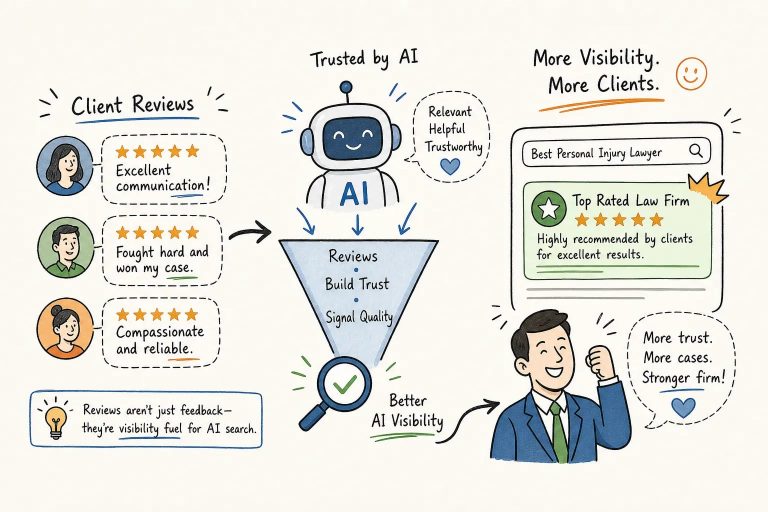
A prospective client opens ChatGPT and types “best personal injury lawyer in Austin.” Three firms come back with specific reasons why each one stands out. One firm has 40 Google reviews. Another has 340. The AI names the second. That’s not a coincidence, and it’s not luck. Understanding the relationship between law firm reviews and AI visibility starts here: your review profile isn’t just social proof for human visitors, it’s structured data that generative AI systems actively synthesize when forming attorney recommendations. Attorneys who treat reviews as a courtesy request at the end of a case are quietly handing referrals to competitors who treat reviews as a core business system.
What follows covers how generative AI systems use your review profile, which platforms carry the most weight for law firm AI visibility, what specific review characteristics influence AI-generated recommendations, and how to build a repeatable acquisition process that stays on the right side of bar ethics rules, along with the measurement framework to know whether any of it is working.
How Generative AI Systems Actually Use Your Reviews
Most attorneys assume tools like ChatGPT or Google’s AI Overviews scan your star rating the way a consumer would on Google Maps. The reality is more indirect, and understanding the actual mechanism changes what you prioritize. These systems don’t query a live review database. They synthesize information from indexed web pages, third-party directories, and editorial articles that reference or summarize review sentiment. If your reviews exist but aren’t reflected in authoritative indexed sources, they’re nearly invisible to AI.
When a client leaves a review on Google Business Profile or Avvo, that content gets indexed. AI systems then draw from those indexed pages, directory profiles, and roundup articles to construct their answers. A firm with 200 reviews and a strong Avvo profile has multiple indexed touch points reinforcing the same reputation signal. A firm with 15 reviews on a single platform gives AI systems very little to work with or cite. The indexing chain, from review to AI answer, is what makes multi-platform presence so valuable for law firm AI visibility.
Volume, recency, and sentiment work as a system, not independently. High volume establishes social proof; recent reviews signal that the firm is still active and performing well. Detailed, sentiment-rich reviews give AI systems the language they need to describe your firm in a recommendation. A single 5-star review with no text has limited influence compared with detailed, sentiment-rich reviews, because AI systems pull on semantic signals, not just averages. A specific review describing a case outcome, the attorney’s name, and the practice area contributes substantially to that signal.
Which Platforms Drive the Most AI Citations for Law Firms
Not all review platforms carry equal weight in AI-generated attorney recommendations. The gap between the top-tier platforms and the rest is significant enough that spreading effort evenly across every available site wastes time and resources. Across tracked legal queries, the same directories appear repeatedly in AI-generated attorney recommendations, and the short list may surprise you.
Google Business Profile
Google Business Profile is the non-negotiable starting point. GBP reviews feed directly into Google’s AI Overviews and AI Mode, and they inform the data layer that other systems pull from when doing web-grounded searches. NAP consistency between your GBP profile and your website is equally critical, because AI systems use that consistency to confirm entity identity before citing a firm. A mismatched phone number or outdated address weakens the signal and can cost you AI citations you’d otherwise earn.
Legal Directories That Shape AI Search Visibility
Beyond GBP, the directories that appear most frequently in AI-generated legal recommendations are Avvo, Martindale-Hubbell, Justia, Super Lawyers, FindLaw, and Best Lawyers. These platforms are indexed, authoritative in the legal vertical, and frequently cited in the kind of roundup articles that AI systems treat as credible third-party validation, making them core to any law firm reviews and AI visibility strategy. Yelp and Facebook, by contrast, appear far less frequently in AI-cited legal recommendations. Prioritizing those platforms for law firm AI visibility is misdirected effort.
The Review Signals That Move the Needle, and Why Law Firm Reviews and AI Visibility Are Linked
Knowing exactly which review characteristics influence AI-generated answers is what lets you act strategically rather than just collect stars.
Specificity beats star ratings every time. A generic 5-star review contributes minimally to AI search visibility. A review that names the attorney, identifies the practice area (“helped me through my Chapter 7 bankruptcy”), and describes the outcome gives AI systems the semantic signals they need to associate your firm with specific legal services. Coaching clients to be specific, without scripting their words, is one of the highest-leverage tactics in legal reputation management. Reviews mentioning case type, attorney name, and outcome consistently produce stronger AI citation performance than volume alone.
Recency is a maintenance metric, not a one-time goal. AI systems treat recent reviews as more reliable indicators of a firm’s current quality than older ones. Consider the difference between a firm with 300 reviews, 280 of which are 18 months old, and a firm with 120 reviews distributed consistently over the past 12 months. Research supports that recency carries significant weight; the second firm sends a fresher, stronger signal despite the lower total count. Stale citation profiles decay faster than most attorneys expect, and a competitor with fewer but more recent reviews can edge out a firm that ran one review campaign three years ago and stopped.
Building a Systematic Review Acquisition Strategy
Getting occasional reviews isn’t the problem most law firms have. Building a repeatable, compliant process that generates reviews consistently is where almost every firm breaks down. Law firms that treat review generation as a manual task handled by whoever remembers to ask will always lag behind firms that build it into their intake and post-case workflow.
The highest-converting moment to ask for a review is immediately after a matter concludes and the client has expressed satisfaction. A warm, brief message explaining that the firm’s online reputation helps other people in similar situations find qualified legal help tends to outperform generic “please leave us a review” requests. The ask should link directly to the preferred platform and make clear there’s no obligation. Bar guidance consistently recommends requesting reviews only after the matter is closed and avoiding any language that ties a benefit to the review’s content.
A dedicated review management tool removes the reliance on memory or manual follow-up and helps ensure no satisfied client falls through the cracks. The result is a steady stream of recent, specific reviews across the platforms that feed both Google local rankings and AI citation algorithms. At Thrive Business Marketing, our Review Builder was built specifically for law firms to do exactly this, automating the follow-up sequence, routing clients to the right platform, and tracking review velocity over time as part of a broader legal marketing system.
Staying Compliant While Building Your Review Profile
Attorney advertising rules apply to review solicitation, and the consequences of getting this wrong are more serious than a bad rating. The good news is that compliance isn’t complicated once you understand the framework. The ABA Model Rules and most state bar guidelines permit attorneys to ask clients for reviews after a matter concludes, provided the request is voluntary, truthful, and does not involve compensation tied to the review’s content.
The rules prohibit scripting the review, offering discounts or gifts linked to a favorable response, and publishing testimonials that disclose confidential case details without informed consent. The FTC’s consumer review rules add a federal layer prohibiting fake reviews, suppressed negative reviews, and undisclosed material connections. Publishing only authentic, unedited reviews from real clients keeps a firm on the right side of both frameworks.
A few practical guardrails worth building into your process: ask only after the matter is complete, and use neutral language that invites honest feedback. Never post a review on a client’s behalf, even with permission. Monitor responses to negative reviews with particular care, public replies can inadvertently disclose confidential information, and that caution deserves its own attention in any review management protocol. If any testimonial will identify the client or include case-specific details on your website or marketing materials, document the consent process in writing before publishing.
Measuring Your Law Firm’s AI Visibility
You can’t improve what you don’t track. AI visibility for law firms is measurable, and the metrics are more accessible than most attorneys expect. The three most useful numbers are citation rate, citation share, and query coverage, and together they give you a clear picture of how law firm reviews and AI visibility interact for your practice specifically.
Citation rate is the percentage of tracked prompts where your firm appears in an AI answer. Citation share is your firm’s mentions divided by total mentions across all tracked firms in the same query set. Query coverage tells you how many of the practice-area and location prompts you track actually surface your firm. To build a baseline, identify 30 to 50 high-intent prompts relevant to your firm, such as “best immigration attorney in [city]” or “personal injury lawyer for car accidents in [county]”, and run them across ChatGPT, Perplexity, and Google AI Overviews on a monthly schedule. Record whether your firm appears, is cited, or is absent. Prompt-set size can vary by practice scope; 30 to 50 is a practical starting range, not a fixed rule.
When AI visibility improves, branded search volume tends to follow. Users who encounter your firm’s name in an AI answer often search for you directly before booking a consultation. Tracking branded query impressions in Google Search Console before and after a review-building initiative gives you a measurable downstream signal. An illustrative benchmark drawn from review-building campaigns: a 30 to 40 percent lift in branded searches over a 90-day period can indicate that your review and citation signals are gaining traction in the systems that matter, though results vary by market and competition level.
The Compounding Advantage of a Review System
Law firm reviews and AI visibility aren’t parallel tracks. They’re the same track. The review quantity, recency, and specificity that improve your Google local rankings are the same signals feeding ChatGPT, Perplexity, and Gemini when users ask for attorney recommendations. Firms that build a systematic, compliant review generation process gain compounding advantages across both channels at once.
The firms pulling ahead in generative search aren’t doing anything exotic. They’re maintaining active profiles on Google Business Profile and the major legal directories, generating specific and recent reviews at a steady pace, and measuring their AI citation share and query coverage monthly, all while staying within their state bar’s ethical guidelines on solicitation. That disciplined, unglamorous consistency is what compounds into durable law firm AI visibility over time.
If you’d rather have a system manage that workflow than add another task to an attorney’s plate, the team at Thrive Business Marketing can help. Our Review Builder is designed for law firms and runs as part of a broader legal marketing system built to turn satisfied clients into compounding visibility across every channel where prospective clients are searching today.