
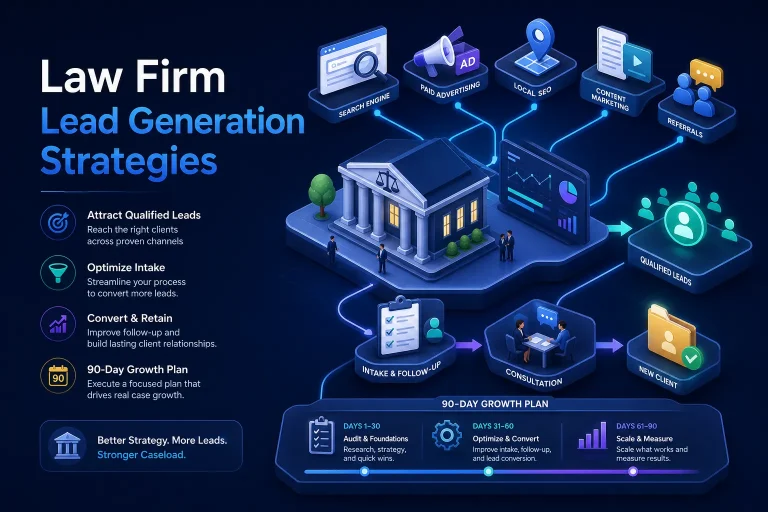
Law firm lead generation often breaks down long before the phone rings. Here’s a pattern that shows up in almost every firm we audit at Thrive Business Marketing: the firm is spending real money on advertising, form fills are coming in, and the phone is ringing, but signed cases aren’t keeping pace. The culprit isn’t the ads. It’s everything that happens after the click. A prospect submits a contact form at 2:14 p.m., no one calls back until 3:45 p.m., and by then they’ve already scheduled a consultation with the firm that picked up in four minutes.
Effective law firm lead generation in 2026 requires more than a Google Ads budget and a decent website. It requires a connected system where traffic, intake, follow-up, and reporting work together rather than on separate platforms managed by separate people. This guide breaks down the four highest-performing acquisition channels for law firms, what leads actually cost by practice area, how to evaluate vendors, and a concrete 90-day plan to put it all in motion.
The four channels driving the most qualified legal leads right now
SEO and local search: the compounding long game
Local SEO typically takes 6 to 12 months to produce consistent organic leads, but once it does, the traffic compounds without ongoing ad spend. For practice areas where clients are searching urgently, like criminal defense or immigration, Google Maps visibility is often the deciding factor between getting the call and being invisible. Roughly 52% of attorneys supplement their organic rankings by listing on legal directories like Avvo and Martindale. For solo practitioners and small firms watching budgets, SEO services in the $500-to-$800-per-month range represent one of the most defensible long-term investments in law firm marketing and client acquisition.
Paid search: immediate volume for high-intent prospects
PPC for law firms can go live within days and put your practice in front of prospects who are actively searching for legal help right now. The smartest use of paid search isn’t as a permanent crutch. It’s a relay strategy: launch PPC immediately to generate leads while your organic infrastructure builds, then reduce paid dependence as SEO matures and drives consistent traffic. Firms that treat PPC and SEO as competitors rather than complements generally end up overpaying for leads over the long run.
Referral networks: still the highest-converting source
According to industry surveys, roughly 70.8% of attorneys cite referrals as their primary source of new clients, and the reason is straightforward: those leads arrive pre-qualified and pre-trusting. That trust advantage shows up in the broader data too, 84% of consumers trust word-of-mouth over any form of advertising, which translates into conversion rates that paid search rarely matches. Attorney-to-attorney referral networks and local bar associations remain underutilized by many smaller firms, which means there’s real competitive upside for any practice willing to invest consistently in relationship-building.
Content marketing and social proof
According to Demand Metric research, content marketing produces roughly three times more leads per dollar than traditional advertising. Separately, Clio’s Legal Trends Report consistently finds that prospects consume significant amounts of content, often several hours’ worth, before hiring an attorney. That’s a long consideration window, and the firms that fill it with useful blog posts, FAQ pages, and short videos are the ones getting called. For a practical playbook on mastering legal content marketing for long-term success, see our guide. Client testimonials and case result summaries tend to build trust more effectively than static brochures because they show rather than tell.
Cost-per-lead benchmarks by practice area (and what they mean for your budget)
Before you can evaluate whether a marketing channel is working, you need a realistic baseline for what legal leads cost in your practice area. The figures below reflect 2026 benchmarks across paid and organic channel mixes. Your actual cost per lead will vary based on your market, targeting, and how well your intake converts. For industry context on what constitutes a reasonable cost-per-lead, consult specialty legal marketing benchmarks.
- Personal injury: $150 to $500+ per lead; 2026 PPC data puts the average at $284 per lead with a 7% lead-to-case conversion rate
- Criminal defense: $50 to $250 per lead; 2026 PPC benchmarks show a 2% lead-to-case conversion rate
- Family law: $50 to $200 per lead, with limited published conversion benchmarks available
- Immigration: $60 to $140 per lead based on available 2026 practice-area data; no widely reported conversion benchmark exists for this category
The math that matters most is cost-per-signed-case, not cost-per-lead. If personal injury leads average $284 and convert at 7%, a firm needs roughly 15 leads to sign one case. Factor in your average case value and you can quickly determine whether a channel’s economics are sustainable. Understanding your lead conversion rate helps translate leads into revenue expectations. A high cost per lead is not automatically a red flag in high-value practice areas where a single signed case can be worth tens of thousands of dollars.
Law firm lead generation vendors: exclusive vs. shared leads
The conversion gap between exclusive and shared packages
Based on lead-industry data, exclusive leads typically convert at 10% to 25%, while shared leads convert at 2% to 8% on average, though actual results vary by practice area and vendor. Shared leads are cheaper upfront, but you’re competing with multiple firms for the same prospect’s attention at the same time, which compresses your window to build rapport. Exclusive packages tend to produce higher average client value because the firm isn’t racing several other attorneys to the phone.
When evaluating vendors, frame the decision around cost-per-signed-case rather than cost-per-lead. To illustrate the math: a shared lead that costs $80 but converts at 3% works out to a cost-per-acquisition of roughly $2,667. An exclusive lead at $200 that converts at 18% works out to about $1,111. The specific rates in your market will differ, but the directional logic holds, paying more per lead for exclusivity often reduces what you pay per signed client.
Ethics and state bar compliance when buying leads
Many lead-generation guides don’t thoroughly cover ethics and compliance, and that gap can create serious professional liability. Under ABA Model Rules, vendors cannot imply they are “recommending” a lawyer based on analysis of a legal problem, as that crosses into improper referral territory. Payment arrangements must not amount to fee-sharing with nonlawyers, and some states require “Attorney Advertising” disclosures on all lead-gen ads. Live, real-time solicitation methods may be restricted depending on your jurisdiction. Colorado introduced lead-generation legislation in 2026 requiring clear disclosure of the specific firm or attorney being marketed, and similar state-level movement is worth watching.
Practical compliance steps before signing with any vendor: review state bar rules in every jurisdiction where you advertise, require the vendor to remove any language that sounds like an endorsement or recommendation, confirm that “Attorney Advertising” disclosures appear where required, and have ethics counsel review the arrangement before you launch. You are responsible for what your vendors say on your behalf.
Intake optimization: where most law firm leads go to die
Law firm lead generation and the 5-minute response rule
Research from MIT and InsideSales.com found that responding within five minutes of a lead submission produces 21 times higher qualification rates than waiting 30 minutes, and that leads contacted within one hour are seven times more likely to convert than those reached after two hours. These aren’t motivational statistics, they reflect how quickly legal prospects eliminate options and move on. Industry guidance on optimal lead response time supports that urgency. A person searching for a criminal defense attorney at 6:45 p.m. has usually contacted two or three firms before deciding who to meet with.
The recommended first-hour sequence for high-intent leads works like this. Send an immediate automated acknowledgment that confirms receipt, states exactly when a human will call, and provides a backup contact path. Follow with a human call or text within five minutes, a second attempt at seven minutes, and a third at twenty minutes if there’s still no answer. Warm leads should receive a response within 15 minutes and multiple touches within the first 24 hours. Research-stage leads can tolerate longer nurture intervals but still need a structured cadence, not a single email and silence.
Why disconnected systems cost firms signed cases
When marketing, intake, follow-up automation, and ROI tracking run on separate platforms managed by separate people, leads fall through the cracks and no one notices until the monthly revenue report comes in short. Integrated platforms built around this problem connect marketing, intake, automation, case management, and ROI tracking into one place so firms can see exactly where each lead is in the pipeline, which channel it came from, and whether the intake team responded in time. That kind of visibility is what Thrive Business Marketing’s CaseFlow System was designed to provide, and it’s the difference between scaling a lead program and simply spending more on one.
How to match your lead strategy to your practice area
High-urgency practice areas: criminal defense and immigration
Clients searching for a criminal defense or immigration attorney are often in crisis. They need fast-loading mobile sites, a strong Google Maps presence, and visible reviews that signal trustworthiness immediately. PPC captures the urgent searcher right now; local SEO builds the trust infrastructure underneath it over time. In these practice areas, intake response speed matters more than almost anywhere else. The research on response time cited above makes clear that faster contact materially increases your odds of winning the consultation, and in high-urgency searches, a firm that consistently responds in four minutes will outconvert one that responds in 45, all else being roughly equal.
Relationship-driven practice areas: family law and estate planning
Family law and estate planning clients often spend weeks or months researching before reaching out. Content marketing and educational blog posts earn trust during that research phase before a prospect ever submits a form. Referral networks and community presence carry more weight here than paid search alone, because the emotional stakes of these practice areas make clients far more likely to act on a personal recommendation than on an ad. Reviews and social proof are especially influential for trust-sensitive decisions, and firms that invest in review generation consistently see higher conversion from organic traffic in these categories.
Your 90-day law firm lead generation plan
Month 1: foundation and fast wins
Launch Google Search PPC campaigns targeting high-intent keywords for your primary practice area so you’re generating leads while everything else builds. Audit and optimize your Google Business Profile for local map pack visibility, this is often the quickest visibility gain available to small firms in competitive markets. Set up an automated intake response system so no lead goes more than five minutes without acknowledgment. If your firm isn’t already listed on Avvo, Martindale, and Justia, get those profiles live and complete before the month is out.
Months 2 and 3: build, scale, and measure
Publish four to six pieces of practice-area content targeting the informational questions your prospects are already searching for. Build or formalize a referral outreach process with past clients and professional contacts, this doesn’t require a complicated system, just consistency. Review your PPC cost-per-lead and cost-per-signed-case data to identify which keywords and ad groups are actually delivering ROI, and cut the ones that aren’t. The data point that will change your budget decisions fastest: confirm that your intake system is tracking which marketing channel each signed client came from. If it isn’t, you’re scaling blind. For practical email nurture sequences and journey planning, see our piece on How Law Firms Can Master the Prospect Journey Through Email.
Build a system, not just a channel
Generating legal leads in 2026 is not a single-channel problem, it’s a systems problem. The firms growing their caseloads consistently aren’t necessarily spending more than their competitors. They’re losing fewer leads at each stage of the process, from click to consultation to signed retainer.
The four-channel framework, the intake sequence, the vendor evaluation criteria, and the 90-day plan in this guide are all designed to work together. Implement any one of them in isolation and you’ll see incremental improvement. Implement them as a connected system and the compounding effect is where the real growth happens. For additional tactics on how email marketing drives law firm growth, review our detailed playbook.
If you’re serious about law firm lead generation, the next step is connecting the channels you’re already using to an intake and reporting system that shows you exactly what’s working. Thrive Business Marketing’s CaseFlow System was built specifically for legal practices that want to close the gap between clicks and signed cases. Reach out and we’ll map out what a connected legal advertising strategy would look like for your firm.
Schedule a free consultation call if you’re interested in learning how Thrive can help frow your firm.