
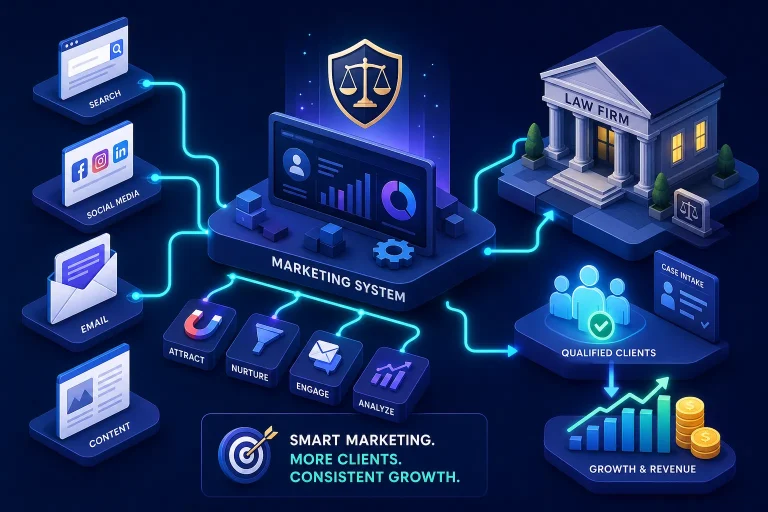
Most law firms have marketing activities. They run Google Ads, maintain a website, and pay an SEO agency for monthly reports. But activities aren’t a law firm marketing system. Leads arrive from different sources, intake is handled manually, and nobody can identify which channel is actually producing paying clients. That gap is more common than most attorneys realize.
At Thrive Business Marketing, we work with law firms across the country, and the pattern is consistent: the firms that grow predictably aren’t the ones spending the most on marketing. They’re the ones running a connected legal marketing system where every layer feeds the next. The firms that stall are managing a collection of vendors who don’t share data and don’t own the full picture.
This guide covers the six core components of a complete attorney marketing framework, the channels that drive qualified intake, the CRM and automation layer that stops leads from leaking, and the reporting cadence that tells you what’s actually working. By the end, you’ll have a clear blueprint for building a system that converts.
What a complete law firm marketing system actually looks like
A law firm marketing system isn’t just a website and a Google Ads account. It’s a connected set of components: search engine optimization, paid advertising, intake and lead management, CRM, review management, and ROI tracking. Each one handles a different part of the client acquisition journey, from getting found online to closing the consultation. Remove one and you create gaps in the pipeline. Remove two and leads start slipping through before you ever know they arrived.
The connection between these components is what most firms skip. Search and ads bring in traffic. Your website converts that traffic into inquiries. Intake captures and qualifies those inquiries. Your CRM tracks and follows up with prospects. Reviews build the trust that makes people choose you over the next result. Tracking tells you which parts of the system are working so you know where to invest more resources. These aren’t standalone tools. They’re stages in a single workflow.
Most firms build this ad hoc: a web developer here, an SEO vendor there, a receptionist handling intake in a spreadsheet. The result is a collection of activities that don’t share data. A lead can enter from a Google Ad, fall through a manual intake process, never receive a proper follow-up, and the firm never knows it happened. Disconnected vendors are a commonly observed problem in legal marketing, and the effect quietly kills conversion rates across every channel.
Key components of a law firm marketing system
- Local SEO and Google Business Profile, builds compounding organic visibility for high-intent searches
- Paid search (PPC), delivers immediate lead volume when intake is dialed in
- Website conversion optimization, turns traffic into consultations, not just visits
- Intake automation and CRM, captures, qualifies, and follows up with every lead
- Review and reputation management, amplifies trust across all channels
- ROI tracking and reporting, closes the loop between marketing spend and signed cases
The client acquisition channels that drive predictable intake
Local SEO and Google Business Profile are the highest-ROI long-term channels for most law firms. High-intent prospects searching for “DUI attorney near me” or “personal injury lawyer in [city]” are ready to call. Ranking in the local map pack builds a steady, compounding source of qualified leads without paying per click. Content marketing layered on top addresses the research-stage questions prospects ask before they ever pick up the phone, building organic authority that paid ads typically don’t replicate over time. For more on balancing and coordinating different channels, see Why Your Law Firm Needs More Than One Marketing Channel.
When a firm needs leads now, paid search delivers. Cost per click in competitive practice areas like personal injury and criminal defense runs high, but when intake is dialed in and speed-to-lead is under five minutes, PPC can produce reliable, scalable case volume. The key is treating paid ads as part of the broader law firm marketing system rather than a standalone tactic. Clicks that hit a slow intake process burn budget without producing clients.
Referrals tend to convert better than cold digital channels, often significantly better than leads from paid sources, according to widely cited lead quality benchmarks across professional services. Online reviews amplify that trust effect: a prospect who finds you through Google and sees a 4.8-star profile with dozens of detailed reviews is far more likely to book a consultation than one who sees a sparse listing. A working legal marketing plan treats reputation management as infrastructure. Generate reviews consistently, respond to them, and your conversion rate improves across every other channel you’re running.
The intake and CRM layer: where leads become clients (or disappear)
Intake automation covers the gap between a lead arriving and a retainer being signed. That includes routing new inquiries to the right person, sending an immediate acknowledgment via email or SMS (see Mastering Email Marketing: Transforming Law Firm Communication & Client Engagement for best practices on automated email workflows), scheduling the consultation, collecting intake forms, and triggering follow-up sequences for prospects who don’t respond. Speed-to-lead is critical here: research from InsideSales and replicated across industries consistently shows that contacting a new lead within five minutes dramatically increases conversion rates compared to waiting even an hour. New approaches to intake, such as AI legal intake,are starting to replace static forms with conversational experiences that improve engagement and completion rates. Without automation handling this, even great marketing produces mediocre results because follow-up is inconsistent.
Choosing the right CRM matters as much as choosing the right channel. For firms already using Clio Manage, Clio Grow is the cleanest integration because it moves a qualified lead into an active matter without duplicate data entry. Lawmatics is a strong choice for firms that want intake automation front-and-center, with e-signatures, scheduling, and SMS built in natively. HubSpot works well for large firms with marketing-heavy operations that need broad integration flexibility (and have significantly larger CRM budgets). Surge by Thrive’s CRM offers budget-friendly customization that fits most small-firm workflows. The right answer depends on your existing stack and how much configuration you’re willing to own.
Without a CRM connected to your marketing channels, you can’t close the loop between ad spend and signed cases. Source-of-lead tracking inside the CRM is non-negotiable for any firm serious about improving their law firm marketing system over time. Firms that implement intake automation tend to convert more leads than those handling intake manually, and the advantage compounds the longer the system runs.
ROI tracking and the KPIs that tell you what’s actually working
Tracking works best when you think in funnel layers. At the top, monitor website traffic, search rankings, and ad impression share. In the middle, watch form fills, inbound calls, consultation bookings, and lead-to-consult conversion rate. At the bottom, focus on cost per acquisition, client acquisition cost, and marketing ROI by channel. Intake metrics like response time and consultation show rate belong in the same dashboard because they directly affect how many leads actually convert to signed clients.
A practical reporting cadence keeps the system improving over time. Weekly reviews should focus on intake activity: calls, leads, form fills, and any conversion drop-offs that need immediate attention. Monthly reports are where you analyze KPIs against targets, compare channel performance, and make budget adjustments. Quarterly reviews form the strategic layer: is the overall system generating the right kind of clients at a cost the practice can sustain? Firms that follow this cadence consistently spot problems before they become expensive and find opportunities before competitors do.
The firms that skip reporting and run their marketing on instinct are the same ones that can’t answer a basic question: which marketing dollar produced a signed case last month? That question should have a clear answer. When it does, every budget decision sharpens, and the overall cost of client acquisition decreases as you shift resources toward what’s working.
Building your stack vs. using an integrated platform
A DIY marketing stack can technically check every box: an SEO agency, a PPC firm, a separate web developer, a CRM subscription, a review management tool, and a reporting dashboard. But each vendor operates in a silo. Data doesn’t flow between them. Nobody owns the full picture. When something breaks or a campaign underperforms, you spend more time coordinating vendors than fixing the problem. The hidden cost isn’t just the monthly invoices, it’s the management overhead and the leads that fall through the gaps.
An integrated platform changes the equation entirely. When every layer shares data, you can see which campaign produced a signed client, not just a click. You can automate follow-up without stitching together three tools. You can make decisions based on real case economics rather than vanity metrics. For most small to mid-sized law firms in competitive practice areas, consolidating into a purpose-built legal marketing system is a practical way to reduce management overhead and close the data gaps that hurt conversion. The goal should be to build a marketing system designed to scale.
That’s the gap the CaseFlow System was built to close. Thrive Business Marketing developed CaseFlow specifically for law firms that are tired of managing a scattered vendor stack. It’s not a collection of tools bolted together, it’s a fully integrated workflow that connects SEO, digital advertising, website performance, intake automation, review management, and ROI tracking into a single managed system. CaseFlow is built around the idea that a law firm marketing strategy only works when the front-end (traffic and visibility) connects directly to the back-end (intake and conversion).
When a prospect finds your firm through search, the system captures that lead, triggers an intake sequence, routes them into a tracked CRM workflow, and records the outcome against the original source. The result is visibility into which marketing dollars are producing signed cases, not just inquiries. CaseFlow is designed for solo practices, small firms, and mid-sized practices in competitive consumer-facing areas, personal injury, criminal defense, family law, immigration, and similar high-intent practice areas.
How to audit your law firm marketing system
Before you build or consolidate, it helps to assess where your current setup breaks down. Work through these questions:
- Can you trace a signed client back to the specific ad, keyword, or referral source that generated them?
- How long does it take your firm to respond to a new web lead, minutes, hours, or longer?
- Are your SEO vendor, PPC agency, and intake process sharing data, or operating independently?
- Do you have a documented follow-up sequence for leads who don’t convert on the first contact?
- Is your CRM tracking lead source, consultation status, and signed/not-signed outcomes?
If more than two of those questions don’t have clear answers, you don’t yet have a functioning law firm marketing system, you have a collection of activities. That’s the starting point, not a failing grade. Most firms land here before they build something that actually scales.
Start building before you’re ready to build perfectly
A law firm marketing system isn’t a luxury. It’s the infrastructure that turns marketing spend into predictable client intake. The firms that build this right gain a compounding advantage: better visibility, stronger conversion, and a clear picture of what’s working. The longer that advantage runs, the harder it becomes for competitors still managing disconnected vendors to catch up.
Whether you build your system piece by piece or use an integrated platform like Thrive’s CaseFlow System, the goal is the same: a connected process where no lead gets lost and every marketing dollar is accountable. Most law firms won’t have everything dialed in from day one, and that’s fine. Start with the components, connect the layers, and track the outcomes. The system improves as data accumulates, and your practice ends up with something most firms never build, a structured client acquisition process that actually scales.
If you’re ready to stop juggling vendors and start running a real legal marketing system, Thrive Business Marketing is here to help. Schedule a 30-minute system audit to see how the CaseFlow System fits your practice areas and current stack.
Frequently asked questions about law firm marketing systems
What is a law firm marketing system?
A law firm marketing system is a connected set of processes and tools, SEO, paid advertising, intake automation, CRM, reputation management, and ROI tracking, that work together to bring in qualified leads and convert them into signed clients. Unlike a collection of standalone marketing activities, a true system shares data across every layer so nothing gets lost between channels.
How is a law firm marketing system different from just running ads or SEO?
Running ads or SEO alone generates traffic or leads, but doesn’t ensure those leads get captured, followed up with, or tracked to an outcome. A complete attorney marketing framework closes that loop, connecting the source of a lead to the intake process, the CRM, and ultimately the signed case. Without that connection, it’s difficult to know which spending is working.
How long does it take to build a law firm marketing system?
A basic system, intake automation, CRM tracking, and a core SEO or PPC channel, can be operational within 60 to 90 days. A fully integrated platform like CaseFlow compresses that timeline because the components are already built to work together. Building piece by piece takes longer but is still better than running disconnected activities indefinitely.
What’s the most important part of a legal marketing system to fix first?
Intake automation typically delivers the fastest ROI improvement, because it captures value from marketing that’s already running. If your intake process is slow or inconsistent, faster lead response and structured follow-up sequences will improve conversion before you spend a dollar more on ads or SEO.
Which CRM is best for a law firm marketing system?
The best CRM depends on your existing tools and how intake-focused you need it to be. Clio Grow integrates cleanly with Clio Manage. Lawmatics is built around legal intake automation. HubSpot suits firms with broader marketing operations. Surge is a cost-effective option for smaller firms. The priority is source-of-lead tracking, whichever platform tracks leads from first touch to signed case is the right one for your law firm marketing system.