
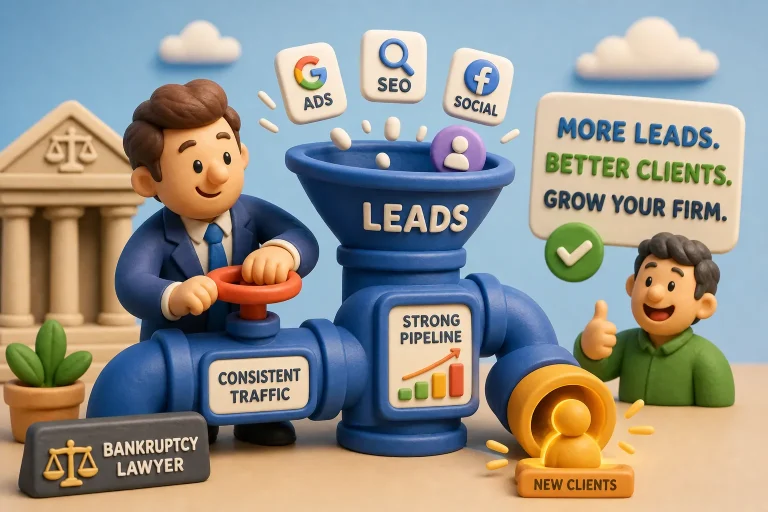
Most bankruptcy attorneys are stuck in one of two traps. They’re buying bankruptcy lawyer leads from providers and hoping the phone rings, or they’re waiting on referrals that show up inconsistently and can’t be predicted. Neither approach builds a practice or scales.
The firms signing Chapter 7 and Chapter 13 clients month after month aren’t just buying more leads. They’re running a connected system: one that tracks every source, qualifies prospects fast, and follows up before the competition even picks up the phone. That’s the framework behind how Thrive Business Marketing built the CaseFlow System, and it’s what this article walks through. Not theory. Practical steps you can apply to your firm this week.
Where bankruptcy lawyer leads actually come from
Leads don’t appear out of thin air. Every bankruptcy client lead traces back to one of four channels, organic search, paid search, purchased leads, and directories or referral networks, and each one has a different cost structure, a different intent level, and a different conversion profile. Knowing the difference changes how you allocate your budget.
Organic Search & Google Maps
Organic search and Google Maps are the highest-intent sources you can tap. A prospect searching “file Chapter 7 near me” or “bankruptcy attorney in [city]” isn’t browsing. They’ve already decided they need help. They’re choosing between you and the firm two listings below you. The Google Maps local pack captures roughly 44% of all clicks on a local legal search page (per local SEO click-through studies on legal SERPs), which means showing up in the top three results isn’t optional for a bankruptcy practice. It’s where the most qualified traffic lands first. Organic SEO takes longer to build, but it produces the most cost-efficient leads over time because you’re not paying per click once rankings are established.
Paid Search
Paid search delivers volume immediately, at a price. CPCs for “bankruptcy attorney” average around $56, and “bankruptcy law” can push to $89 in competitive markets. The average cost per lead from legal PPC sits around $82, with monthly budgets typically ranging from $3,000 to $10,000 to generate meaningful case volume. PPC works. It just works best as a complement to organic rankings, not as your only channel.
Purchased Leads
Purchased bankruptcy lawyer leads from providers like 4LegalLeads, Webrageous, Legal Brand Marketing, and Gorilla Web Tactics give you a direct pipeline of prospects who have expressed interest and can be geographically targeted to your market. This channel delivers volume on demand, but quality varies significantly by provider and exclusivity tier.
Directories & Referral Networks
Legal directories and referral networks add warm bankruptcy attorney leads to the mix, but with inconsistent volume you can’t control. Both serve a purpose. The mistake is treating either as the foundation of your entire growth strategy.
What exclusive and shared bankruptcy lawyer leads cost
Pricing varies enough across markets and providers that vague ranges are useless. Here are the real numbers so you can evaluate any provider’s offer with a clear baseline.
Exclusive leads go to a single firm. Nobody else is calling that prospect. That exclusivity carries a real price: $100 to $300 per lead nationally, with major metros like New York, Los Angeles, and Chicago pushing toward the top of that range. Smaller markets average $50 to $100. Exclusive leads convert at 18 to 25%, with some providers reporting appointment booking rates approaching 40% within 72 hours when intake response is fast. The math holds up. If your average Chapter 7 case generates $1,500 to $2,000 in fees and a Chapter 13 brings $3,500 to $4,000, a single signed client covers five to ten purchased leads at $150 to $200 each.
Shared leads are priced at $15 to $60 per lead and go to two or three firms simultaneously. The lower price looks appealing until you calculate what actually happens. Conversion rates drop to 6 to 12% because you’re competing with other attorneys the moment the lead is generated. Semi-exclusive leads run $75 to $125 and sit in the middle ground, cheaper than exclusive, but you still need aggressive follow-up to win the case. The true cost of shared leads isn’t the price tag. It’s the intake staff time spent chasing prospects who already signed with a faster firm.
Chapter type also shifts pricing. Chapter 7 exclusive leads average $75 to $150 because the cases are simpler and the prospect timeline is compressed. Chapter 13 exclusive leads run $100 to $200, reflecting longer case timelines and higher complexity. Before comparing any provider’s pricing to a national average, run your own market numbers. A $200 exclusive lead in a competitive metro is a different conversation than the same lead in a mid-sized market.
The factor most firms ignore: response time
Pricing is only half the equation. Lead source matters. Lead quality matters. But neither outweighs one variable that many firms consistently underestimate: how fast you respond.
According to research from MIT and InsideSales.com, leads contacted within five minutes convert at 21%. Wait 24 hours and that rate drops to 7%. By 48 hours, the prospect has usually hired someone else or given up on the process entirely. This applies across every channel: organic form submissions, purchased exclusive leads, directory inquiries, and paid ad conversions. The channel doesn’t save you if your response is slow.
Exclusive leads outperform shared leads at 18 to 25% versus 6 to 12% for one primary reason: the prospect only hears from you. No competing calls, no comparison shopping while they wait for your follow-up. Organic and Google Maps leads often perform even better than purchased exclusives because the prospect sought you out. They initiated contact. That’s a higher-intent signal than any purchased lead can provide.
Many bankruptcy firms don’t have a lead volume problem. They have a response time problem. The fix isn’t buying more leads. It’s building automation and defined intake protocols so that every lead, regardless of source or time of day, gets a response within minutes. Platforms like Lawmatics are purpose-built for legal intake automation and can substantially increase conversion rates before you spend another dollar on lead acquisition.
How to qualify a bankruptcy prospect without wasting staff time
Not every lead is worth pursuing at the same depth. High-intent bankruptcy prospects share predictable markers, and learning to spot them fast protects your team’s time and your marketing budget.
Strong indicators include substantial documented debt, a specific triggering event such as a lawsuit, wage garnishment, or foreclosure notice, and a near-term filing timeline. These are recommended intake heuristics, not rigid cutoffs, but they give your team a consistent framework for prioritization. Chapter 7 prospects typically have lower income and fewer assets. Chapter 13 prospects have regular income but need debt restructuring. Your intake questions should branch based on which chapter fits their situation so you’re qualifying efficiently rather than running every prospect through the same generic script.
Behavioral signals matter just as much as financial details. A prospect who fills out a complete form, answers every field, and calls during business hours is signaling genuine urgency. A minimal inquiry submitted at midnight with no callback number is probably still in the research phase. That doesn’t mean you abandon it, but it changes how you prioritize your follow-up queue.
Three questions cover most of what you need on first contact: How much total debt are you dealing with? Is there any legal action currently pending against you? When are you looking to file? The answers tell you whether to schedule a consultation immediately or move the prospect into a longer nurture sequence. Rapid qualification saves hours of intake time every week and keeps your team focused on the prospects who are actually ready to move. For firms focused on content-driven client acquisition, see mastering legal content marketing for long-term success for actionable strategies to convert lower-intent leads over time.
Why buying individual leads creates a ceiling on your growth
Purchasing bankruptcy attorney leads from one or two providers without tracking, a CRM, or intake automation is a constant restart. You can’t identify which sources are converting at the highest rates, you can’t optimize spend based on actual case outcomes, and you can’t scale without simply spending more money and hoping results improve proportionally. They rarely do.
Firms that rely entirely on purchased legal leads for bankruptcy clients are renting growth. Stop paying and the pipeline stops. That’s not a business model. It’s a dependency. The attorneys building practices that grow year over year are running multi-channel systems, SEO, Google Maps presence, paid ads, and purchased leads, all feeding into a single intake and tracking system that shows exactly what’s working.
A functional lead system captures every source, routes leads to intake immediately, tracks every contact, and reports which channels are producing profitable cases. ROI tracking closes the loop in ways that manual processes simply can’t. If a $200 exclusive lead generates a $4,000 Chapter 13 case, you know that. If your Google Maps leads convert at twice the rate of your paid leads, you know that. Without tracking, you’re guessing at which sources to scale and which to cut.
Intake automation handles the critical first response within minutes regardless of when a lead comes in. After-hours form submissions get an immediate automated response that books a consultation or starts the qualification sequence. That alone can meaningfully increase conversion compared to firms waiting until the next morning to return calls. Lawmatics and similar legal CRM platforms make this accessible even for smaller practices. To learn more about effective web content and conversion-focused messaging that supports this system, read Mastering Law Firm Web Content: Strategies for High-Conversion Legal Writing | Thrive Business Marketing.
Building a pipeline that doesn’t restart every month
The goal isn’t a better lead source. The goal is a system where every channel feeds into connected intake, every lead is tracked from first contact to signed retainer, and every dollar spent on marketing can be traced to a case outcome. That’s what separates firms that grow from firms that scramble.
Firms serious about building a scalable bankruptcy lawyer lead pipeline typically benefit from a legal marketing partner who handles SEO, local presence, paid advertising, and intake automation in one connected system, rather than three disconnected vendors with no visibility into each other’s results. That’s the problem Thrive Business Marketing’s CaseFlow System was built to solve. It integrates digital marketing, intake automation, and ROI tracking so law firms can see exactly where their clients are coming from and which sources are worth scaling month over month.
Before you buy another batch of bankruptcy lawyer leads, ask one honest question: do you actually know what’s happening to the leads you’re already getting? If you can’t answer that, start there. Fix the intake system first, and your existing bankruptcy lawyer leads will start converting at a rate that justifies whatever you spend next. More leads fed into a broken intake process is just more money wasted faster. Build the infrastructure first, then scale the spend. Also consider how ongoing communication can rescue lower-intent prospects, learn how email marketing drives law firm growth to create nurture sequences that turn research-phase leads into consultations over time.