
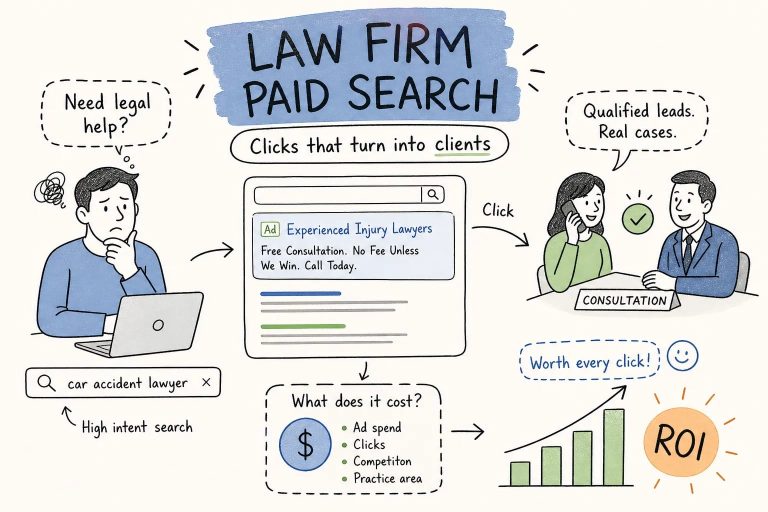
Law firm paid search is one of the most expensive and tightly regulated advertising environments in any industry. Unlike e-commerce or SaaS, a mismanaged legal PPC campaign can burn through thousands of dollars in days, or expose a firm to bar complaints. Many firms jump into Google Ads for lawyers without fully understanding the bid landscape, the compliance layer, or how to connect clicks to signed cases. That gap between spending and results is where most legal advertising budgets quietly disappear.
This guide explains how paid search actually works for law firms: what you’ll spend, how to structure campaigns, the compliance rules that govern your ad copy, and the tracking setup you need to measure real ROI. Whether you’re running your first campaign or auditing an existing one, this is the foundation you need before spending another dollar.
Why legal paid search operates differently from most industries
Attorney paid search operates under constraints that most advertisers never face: extremely high cost-per-click rates, strict professional advertising rules, and a conversion funnel that ends at a signed retainer, not a checkout confirmation. Understanding this context isn’t optional. It shapes every budget decision, every headline, and every campaign structure you build.
The compliance layer most advertisers never deal with
State bar advertising rules govern what a law firm can say in an ad, and these rules vary by state. Unsupported superlatives, outcome guarantees, and certain testimonial formats are off-limits in ways that would never apply to a retail advertiser. This compliance layer shapes every headline, callout extension, and landing page you put in front of a prospective client.
Why clicks in legal cost so much more
Searchers in legal markets represent high case values, low search volume, and intense competition among firms bidding on the same narrow keyword sets. A “car accident lawyer near me” search in a major metro regularly costs $150 to $300 per click, with top-intent terms exceeding $400. This isn’t a broken system; it reflects what a signed personal injury client is actually worth to a firm.
The intake gap: where most law firm PPC money disappears
Most firms lose ROI not in the ad itself but in what happens after the click. Slow intake response, untracked calls, and unqualified leads counted as conversions all create a false picture of campaign performance. Paid search for law firms only works when the marketing side and the intake side operate as one connected system. Leave the intake gap open and you’re funding a leaky funnel indefinitely.
What law firm PPC actually costs by practice area
Before setting a budget, you need realistic benchmarks. The numbers below represent planning ranges, not guarantees. Metro markets, keyword intent, and campaign quality will push your actual costs in either direction.
- Personal injury: $70, $250+ CPC | $300, $1,500 cost per lead
- Criminal defense / DUI: $45, $120 CPC | $150, $600 per lead
- Family law / divorce: $15, $50 CPC | $85, $200 per lead
- Estate planning: $10, $35 CPC | $55, $150 per lead
- Immigration: $10, $40 CPC | $60, $140 per lead
Personal injury sits at the extreme end because case values justify the spend. A single retained PI client can generate five or six figures in attorney fees, a return that explains why firms bid aggressively for every click. In major metros like Los Angeles, Houston, or Chicago, average CPCs in this category regularly exceed $200.
How law firm paid search budgeting works: calculating true cost per signed client
The numbers above represent cost per lead, not cost per signed client. Those are very different figures. To find the number that actually determines campaign profitability, divide your cost per lead by your lead-to-client rate. A $200 lead cost with a 15% lead-to-client rate implies roughly $1,333 per signed client, before agency fees and intake costs. That is the number worth optimizing. As a general rule of thumb, criminal defense firms tend to convert 15, 20% of leads to clients; personal injury firms are typically closer to 7.5%, which explains why their cost-per-client figures can run surprisingly high even when lead costs appear reasonable.
Campaign structure that generates high-quality leads
How you build your campaigns determines whether you generate qualified consultations or junk volume. Structure is where most DIY Google Ads setups break down, not the budget. The sections below cover the three structural decisions that matter most for law firm paid search: campaign separation, ad group organization, and secondary targeting.
Brand vs. non-brand campaigns and why both matter
Brand campaigns capture existing demand from people searching your firm’s name who already know you exist. Non-brand campaigns drive new prospect acquisition through problem-based searches like “DUI attorney near me” or “wrongful termination lawyer.” Non-brand campaigns are where new clients come from, and blending them with brand campaigns distorts performance data, making budget allocation nearly impossible. Keep them separate from day one.
Tightly themed ad groups by legal problem
Instead of one broad “lawyer” ad group, create tightly grouped sets organized by specific legal problem and intent. “Rear-end accident lawyer,” “felony defense attorney,” and “uncontested divorce lawyer” each deserve their own ad group with matching ad copy and, where possible, a dedicated landing page. When keyword, ad, and destination page align precisely, Quality Scores improve and conversion rates follow. Aggressive negative keyword lists are equally critical, exclude job searches, law school queries, legal aid terms, and self-representation research before any campaign goes live.
When competitor targeting and remarketing make sense
Treat these as secondary priorities, not the foundation of your strategy. Competitor campaigns can be useful but are expensive and qualify traffic less precisely than problem-based non-brand terms. Remarketing works best after you have sufficient traffic volume and should be segmented by behavior: page viewers, form abandoners, and high-engagement visitors each need different messaging. Run high-intent non-brand search first, then layer in remarketing once you have enough data to segment meaningfully.
Ad compliance rules that shape every legal PPC campaign
This is the section most legal marketing guides skip entirely, and where law firms face the most risk. What follows is practical guidance, not legal advice, but it reflects what firms running compliant campaigns need to understand before going live.
What your ad copy legally cannot say
ABA Model Rule 7.1 prohibits false or misleading claims, unverifiable superiority statements, and outcome promises. “Best lawyer,” “#1 attorney,” “guaranteed results,” and “maximum compensation” are all off-limits unless objectively supportable and locally permitted. Testimonials and case results require disclaimers in most states clarifying that prior results don’t guarantee future outcomes. Specialist and credential claims under Rules 7.2 and 7.4 carry jurisdiction-specific restrictions, confirm your state’s exact language before using terms like “certified” or “specialist” in any ad asset.
Targeting practices that create compliance exposure
Three targeting issues attorneys frequently overlook can create real problems. First, geo-targeting must match the firm’s licensed jurisdictions; location settings alone are not a complete safeguard, because users can search from outside selected areas. Second, bidding on a competitor’s name as a keyword may be permitted, but using that name in ad copy can create deception issues under state rules. Third, audience targeting based on sensitive legal circumstances, accident involvement, arrest records, or debt situations, can raise solicitation concerns under Model Rule 7.3, which governs direct solicitation of prospective clients.
A pre-launch compliance checklist for legal PPC
- Identify every state the campaign targets and confirm licensure in each.
- Remove guarantees, unsupported superlatives, and unverified outcome claims from all ad copy and extensions.
- Add required identity disclosures, fee disclaimers, and “Attorney Advertising” labels where your state requires them (New York and Texas have specific mandated language).
- Review your ad copy, extensions, call assets, and landing page as one complete communication, not separately.
- Preserve final ads, targeting settings, and approvals for the retention period each targeted state requires.
Law firm paid search: tracking and ROI
Most firms track clicks and form submissions, then wonder why those numbers don’t match revenue. The gap exists because clicks and forms measure marketing activity, not business outcomes. A proper legal PPC tracking setup closes that gap completely.
The tracking stack law firms actually need
The minimum viable stack connects GA4 to Google Ads through Google Tag Manager, pairs that with a call-tracking platform using dynamic number insertion, validates form-submission events, and connects to a CRM that records intake stages from first inquiry to signed retainer. Dynamic number insertion works by swapping the displayed phone number on your landing page for a trackable number tied to the specific paid-search session. When a visitor calls, that call is attributed back to the campaign, ad group, and keyword that generated it. Without this, you’re guessing which ads drive phone business.
Conversion events worth tracking, and which ones to ignore
The most common mistake is treating every form fill as a conversion. The hierarchy of meaningful events runs from form submit through click-to-call, connected and qualified call, consultation booked, consultation completed, retainer sent, and finally signed matter. Only qualified consultations and signed matters should drive Google Ads bidding decisions. Raw form submissions and page clicks belong in analytics as diagnostic signals, not in your primary conversion column.
Closing the loop with offline conversion import
Once a lead moves to a signed client in your CRM, that outcome gets sent back to Google Ads with the original click ID attached. This tells Google’s algorithm which campaign, ad group, keyword, and ad produced the actual case, not just the inquiry. The process requires capturing the Google Click ID at form submission, associating it with the CRM record through all intake stages, then exporting signed-matter records back to Google Ads on a scheduled basis. Firms that skip this step optimize for lead volume. Firms that use it optimize for signed clients. The difference compounds over months of campaign data.
In-house vs. hiring a legal PPC specialist
At some point, every firm running paid search faces this decision. The answer depends less on firm size and more on the complexity and spend level you’re managing, and on whether the current setup is generating accurate data in the first place.
Signs you’ve outgrown DIY campaign management
A few clear signals indicate that the cost of mismanagement has exceeded the cost of expertise. Consider getting outside help when you’re dealing with any of the following:
- Monthly ad spend in the low-to-mid thousands, where daily optimization decisions have a meaningful dollar impact
- Compliance requirements spanning multiple states or practice areas
- No reliable call tracking or offline conversion import currently in place
- Intake and marketing operating in separate silos with no shared data
When these conditions are present, the optimization decisions being made daily by an unqualified manager are actively costing the firm money, not just time.
What a qualified legal PPC agency actually looks like
The agency must understand state bar advertising rules well enough to write compliant copy across jurisdictions, not just run generic Google Ads for lawyers. They should have direct experience with the bidding dynamics specific to legal practice areas, a clear method for tracking paid search marketing for attorneys all the way to signed cases, and no conflict of interest from serving competing firms in the same market. When evaluating options, agencies like Thrive Business Marketing that are built specifically around legal-industry depth offer a structural advantage: compliance knowledge and competitive bidding strategy are part of how campaigns are managed from day one, not retrofitted after the firm has already spent money on non-compliant ads.
The bottom line on law firm paid search
Law firm paid search rewards precision and punishes assumptions. The attorneys who see strong ROI from PPC aren’t necessarily spending more; they’re spending on the right campaigns, tracking the right outcomes, staying within compliance guardrails, and connecting their marketing data to actual case intake.
The practical next step for any firm is to audit what’s already in place. Are campaigns separated by practice area? Is call tracking connected to the CRM? Is ad copy reviewed against state bar rules for every targeted state? Is Google Ads optimizing toward signed matters or just raw leads? Each of those questions has a yes or no answer, and the nos are where your budget is leaking.
Start there. Whether you manage attorney paid search in-house or work with a specialist, the answer to each question determines whether your next campaign dollar produces a client or a spreadsheet entry that never converts. To discuss what that audit looks like for your firm, reach out to the team at Thrive Business Marketing.