
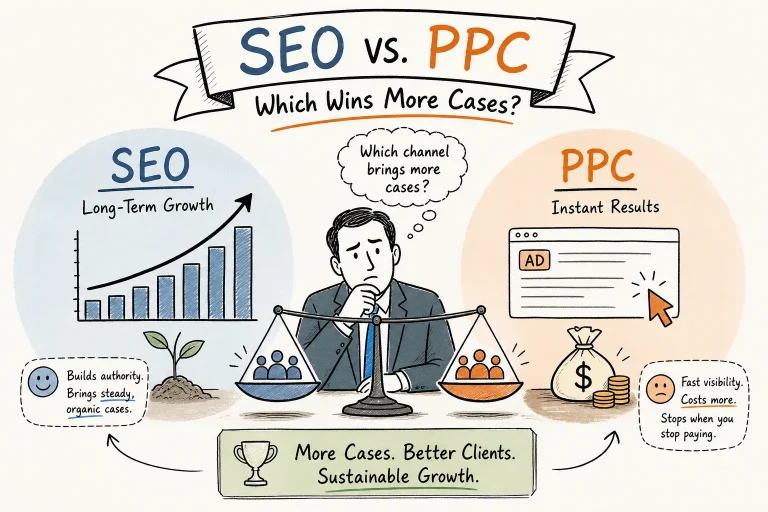
When weighing law firm SEO vs. PPC, most attorneys run into the same problem: every marketing vendor insists their channel is the one that wins cases. Google Ads agencies show pipelines full of immediate leads. SEO companies show compounding organic traffic graphs that look great on slide decks. What most attorneys walk away with is a more expensive monthly retainer and no clearer answer about what actually works for their firm.
Here’s the honest answer: there is no universal winner in the SEO vs. PPC comparison for law firms. The right channel depends on your practice area, your timeline, your budget, and where your ideal client sits in the decision process. Many of the fastest-growing firms aren’t choosing one channel over the other, they’re running both with connected tracking. The performance patterns behind that approach shape how Thrive Business Marketing structures dual-channel strategies through our CaseFlow System, and they’re consistent across practice areas and markets.
By the end of this article, you’ll have a clear picture of how each channel actually works, which fits your practice area best, and a simple budget allocation model you can act on immediately. No generic advice, no vendor spin.
Law Firm SEO vs. PPC: How Each Channel Serves the Client Journey
The biggest mistake attorneys make when comparing these two channels is treating them like competitors for the same client. They aren’t. They reach people at completely different moments in the decision process, which is why picking one based on cost alone almost always leads to the wrong call.
When a prospect is searching right now: the PPC advantage
Paid search captures urgency. A person arrested last night isn’t spending two weeks reading blog posts about criminal defense attorneys. They’re typing “criminal defense lawyer near me” at 9 a.m. and calling the first firm that looks credible. Google Ads puts your firm at the top of that search before any trust or brand recognition exists. You’re not creating awareness with paid search. You’re showing up at the exact moment someone already knows they need a lawyer and is ready to call.
That demand-capture mechanic makes PPC irreplaceable for practice areas where the triggering event creates immediate urgency. In high-stakes practice areas, delays in reaching a prospect often mean that prospect has already hired a competitor. Paid search wins that race.
When a prospect is researching before the crisis: where organic search wins
Organic search for law firms operates on a completely different timeline. Family law cases, estate planning consultations, and immigration matters often involve weeks or months of research before anyone picks up the phone. A prospective client navigating a divorce is reading about the process, understanding what an attorney costs, and deciding who seems trustworthy, and doing all of this before they’re ready to schedule a call.
A firm with strong organic rankings gets in front of that prospect during the research phase, builds familiarity, and earns the call when the client is finally ready to act. Over time, the cost per lead from organic search drops well below what paid search charges for the same visibility. Research consistently shows SEO’s long-term ROI runs roughly 3.5x higher than paid ads over a three-year window, making local SEO for lawyers one of the most cost-effective investments a firm can make once organic rankings stabilize. For a practical roadmap of the tactics that matter, see What are the most important SEO strategies for a law firm to stand out in a competitive online market?
Law Firm SEO vs. PPC by Practice Area: Where Each Channel Wins
General marketing theory only gets you so far. Attorneys need to see their own practice area reflected in the data before any channel recommendation makes sense.
Personal injury and criminal defense: why PPC dominates despite the cost
Personal injury is the most expensive legal niche in paid search, and for good reason. Average CPCs range from $70 to $250 or more in competitive markets, with metro-area terms like “truck accident lawyer” regularly hitting $300 to $500 per click. Cost per lead for quality PI leads runs $500 to $1,500, figures that reflect competitive market reality, not the broader industry averages that understate what firms actually pay.
Despite the premium cost, PPC wins in personal injury because a single signed case can return significantly more than total ad spend, documented returns commonly run 4x to 7x, and top-performing campaigns push higher. The math works. Criminal defense operates under the same logic: the triggering event creates immediate, high-intent search behavior. Firms that rely solely on SEO in these practice areas will consistently lose urgent searches to competitors who are running ads. Organic rankings still matter for PI and criminal defense, but they can’t replace paid visibility when someone needs a lawyer today.
Family law and immigration: where organic search builds stronger long-term ROI
Family law and immigration attract clients who research extensively before contacting anyone. CPCs are lower, typically $25 to $75 for family law and $10 to $50 for immigration, and the research-heavy nature of these cases means organic content has real time to influence the decision. A well-written article on what to expect during a divorce consultation, ranking on page one, generates consultation requests for months without ongoing ad spend.
For firms in these practice areas that aren’t competing in the largest metro markets, an SEO-first strategy makes stronger financial sense. The upfront investment takes longer to produce volume, but the cost per lead drops significantly once organic rankings stabilize. An immigration firm in a mid-sized market that ranks organically for “immigration lawyer [city]” doesn’t need to pay $40 per click every time someone finds them.
The Real Cost and Timeline Behind Each Channel
Attorneys who’ve been burned by marketing agencies typically got burned the same way: one channel was oversold without an honest conversation about its limitations. Here’s what both channels actually cost and how long they actually take.
What paid search actually costs per lead (beyond the averages)
Personal injury firms in major metros need $10,000 or more per month in ad spend just to generate 10 to 35 leads. Conversion rates from click to signed client typically run 5 to 15%, which puts the true cost per signed case in PI between $800 and $2,500. An analysis of 500+ firm campaigns, tracking attribution through to signed retainer rather than just inquiry, confirms that range holds across competitive markets when reporting is done correctly. For broader market benchmarks you can reference industry Google Ads benchmarks for law firms.
Criminal defense and family law firms see better numbers: $300 to $900 per signed case when campaigns are managed well and intake is optimized. The firms spending $10,000 per month and generating $4 to $7 in case value for every dollar spent are doing something right. The firms not tracking results at that level of detail are almost certainly spending more than they think per signed case.
The SEO timeline attorneys rarely hear about upfront
Meaningful organic traffic from legal SEO starts appearing at three to six months for long-tail queries. Competitive practice-area rankings in major markets take six to 12 months. Local map pack visibility moves faster, often 60 to 90 days for firms with a verified Google Business Profile and consistent review generation. That’s the fastest organic win most attorneys haven’t claimed yet, and it’s one of the clearest early wins available through local SEO for lawyers.
New websites starting from zero authority face a harder timeline. Consistent, predictable case inquiries from organic search for a brand-new site realistically take 12 to 18 months. That’s not a reason to skip SEO. It’s a reason to start immediately so the compounding effect is working in your favor 12 months from now, while paid search covers your leads in the interim.
Budgeting for Law Firm SEO vs. PPC: A Practical Allocation Framework
Understanding both channels is useful. Knowing where to put your next dollar is actionable. Here’s a practical framework based on firm size and growth stage. If you’d like a focused comparison on whether to prioritize SEO or paid advertising, read our full guide on Should I focus my marketing budget on SEO or Paid Advertising (PPC) to get the best results for my business?
New or small firm: start PPC-heavy while SEO builds in the background
Small firms in competitive markets typically need to skew 70% of their marketing budget toward PPC and 30% toward SEO. The reason is simple: SEO won’t produce meaningful volume for months, and a small firm without cases doesn’t have the runway to wait. A realistic entry point is $5,000 to $10,000 per month for paid search, depending on practice area, paired with $2,000 to $3,000 for foundational SEO work including local listings, Google Business Profile optimization, and core content.
That SEO investment in the background isn’t wasted money during the PPC phase. It’s building authority so that six to 12 months later, organic leads start supplementing paid volume instead of the firm remaining 100% dependent on ad spend indefinitely.
Growing midsize firm: shift toward a balanced or SEO-dominant model
Midsize firms with established cash flow and brand recognition can move toward a 50/50 or even 60% SEO/40% PPC split. At this stage, organic rankings reduce dependence on paid spend for every single lead, which improves overall marketing ROI as the firm scales. Large firms often spend $10,000 to $20,000 monthly on SEO alone while maintaining aggressive paid search budgets for consistent volume.
The shift toward SEO isn’t about cutting paid search. It’s about not needing paid search to carry 100% of the load. When organic leads are flowing consistently, paid campaigns can be optimized for the highest-value case types rather than serving as the only source of new business.
Why Running Both Channels Together Consistently Outperforms Either Alone
The data on combined strategies is compelling. In one documented case study, a personal injury firm using an integrated SEO and PPC approach achieved 86.84% annual revenue growth, well above industry benchmarks, while simultaneously decreasing monthly ad spend by $57,000. Return on ad spend improved from 4.10:1 to 9.45:1. That outcome reflects what consistently happens when both channels feed the same funnel with connected attribution, not isolated budgets reporting into separate dashboards. Industry law firm lead generation statistics also show firms that combine channels see improved lead quality and conversion.
The compounding effect of covering intent at every stage
When a prospect reads your organic content about family law options and later sees your firm’s name in a paid search result or retargeting ad, recognition compounds. They’ve already encountered your firm as a resource before seeing your ad. That familiarity lifts conversion rates on paid campaigns significantly above what cold traffic alone produces. The two channels reinforce each other in a way that neither can replicate independently.
Retargeting campaigns aimed at users who already visited your organic content pages convert at higher rates than cold paid traffic, the content builds intent, and the paid ad captures it at the right moment. Running both channels means you’re not leaving that conversion opportunity on the table.
How Thrive’s CaseFlow System eliminates the multi-vendor problem
Most law firms running both SEO and PPC work with separate vendors who don’t share data, can’t agree on attribution, and produce reports that don’t connect to signed cases. The result is a firm spending on two channels without any reliable way to know what’s actually working. Thrive Business Marketing’s CaseFlow System was built to solve exactly this problem. It integrates paid search, organic strategy, intake automation, and ROI tracking into one connected system. Every dollar spent on either channel ties back to the cases your firm actually signed. One team, one dashboard, one source of truth. We also address common multinational issues and explain why global PPC consistency fails for multinational law firms in practice.
Three Questions That Make the Decision Clear
The law firm SEO vs. PPC debate doesn’t need to be complicated. Most attorneys can make a solid channel decision by working through three honest questions about their firm’s situation.
- Do you need cases in the next 30 days, or are you building a 12-month pipeline? If the answer is 30 days, paid search is your immediate priority. If you have runway, SEO investment now pays off significantly later.
- Is your practice area driven by urgent, crisis-driven searches or extended research behavior? Personal injury and criminal defense firms need PPC coverage for high-intent searches. Family law, estate planning, and immigration firms get stronger long-term ROI from organic rankings.
- Does your current budget support meaningful investment in one channel or both? Under-investing in PPC, for example, $1,000 per month in a competitive PI market, produces worse results than doing nothing. Spend where you can actually compete.
For most law firms, the answer to the SEO vs. PPC for law firms question isn’t one or the other. Practice areas and timelines vary, but the firms with the most consistent case volume run both channels with unified tracking that connects marketing spend to signed retainers. That’s what separates firms that grow from firms that generate a lot of marketing activity without knowing why some months are better than others.
If you’re ready to stop guessing and start running both channels as a connected system, Thrive Business Marketing’s CaseFlow System is built for exactly that. Reach out to see how it’s structured for your practice area and market.