
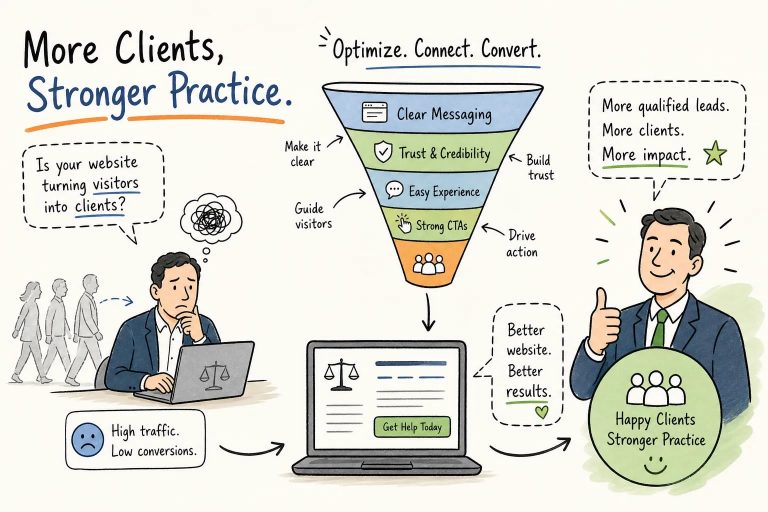
Law firms pour significant budget into SEO, Google Ads, and social campaigns to drive traffic. But here’s the problem most firms don’t talk about: the majority of that traffic leaves without requesting a consultation. All that spend, and the site itself is the leak, a legal website conversion problem many firms never diagnose.
The average law firm website converts between 2% and 4% of its visitors. High-performing practice-area pages and optimized landing pages typically reach 6% to 15%, based on data from Unbounce’s conversion benchmark report and CUFinder’s legal industry analysis (median landing page: 6.3%; top 10% of firms: approximately 11.5%). That gap is not a traffic problem. It’s a conversion problem, and every percentage point you close represents real consultations your competitors are booking instead of you.
What follows is a field-tested breakdown of 10 specific tactics, organized by where they fit in the visitor journey. Working with law firms across the country, the most consistent finding is that conversions don’t break down in one place, they leak at multiple points, and fixing the right ones in the right order is what moves the needle. By the end, you’ll have clear benchmarks, a prioritized list of changes, and a framework for measuring what actually worked.
What law firm website conversion rates actually look like in 2026
Before prescribing fixes, you need a baseline. Without knowing where a typical firm lands, you can’t evaluate how significant your own gap is or which tactics deserve priority attention.
Overall law firm websites average between 2.6% and 3.8% conversion rate across all traffic sources. Legal landing pages, the dedicated high-intent pages built for a specific practice area or campaign, hit a 6.3% median, with the top 10% of firms reaching 11.5%. The distance between those two numbers tells you exactly how much opportunity lives inside page-level optimization. Improving your attorney website conversion rate by even two to three percentage points can translate into dozens of additional consultations per month without spending more on traffic.
Conversion rates also vary significantly by page type. Homepages tend to convert between 2% and 5%, while practice-area pages typically land at 4% to 8%. Contact and consultation form pages, where intent is highest, often convert at 8% to 15%. Optimized PPC landing pages regularly exceed 10% because the traffic arriving there has already made a significant decision.
Practice-area benchmarks worth tracking include disability law and family law at a 6.3% median, immigration law at 5.6%, and niche areas like bankruptcy and tax law reporting even higher rates in some analyses. These are targets, not ceilings. Knowing your category benchmark tells you whether you’re leaving 2 percentage points or 10 on the table.
Legal website conversion: CTA placement and above-the-fold messaging
Three of the highest-impact tactics in this guide live in the first screen a visitor sees. Get this wrong and nothing else on the page matters, because most visitors decide whether to stay or leave within seconds.
The hero section needs to immediately name the practice area and geography. “Houston Personal Injury Lawyers” with a single dominant CTA typically outperforms a clever tagline, a principle supported by message-match research across multiple industries. This is called message match: the headline on a landing page should mirror the ad or search result that brought the visitor there. When those align, the visitor feels instantly understood. When they don’t, they bounce. One clear CTA above the fold, not three competing options, is the standard that converts.
The mobile sticky CTA is consistently the highest single-tactic impact change for legal sites. A button fixed to the bottom of mobile screens on every practice-area page keeps the action visible no matter how far a user scrolls. A majority of legal search traffic now comes from mobile devices, and if your CTA disappears when someone scrolls past the hero section, the consultation doesn’t happen. Implement this on all practice-area pages and the contact page.
Dedicated landing pages by keyword cluster are the third piece. Separate pages for “car accident lawyer,” “truck accident lawyer,” and “wrongful death lawyer” each convert better than a single general practice page. The principle is specificity: a visitor searching for a DUI attorney doesn’t want to land on a page that also covers wills and estate planning. These dedicated pages also improve Quality Score for paid campaigns, which directly reduces your cost per lead.
Contact form design and alternative capture flows
The form is the moment of truth. Most firms make one of two mistakes: they ask for too much too soon, or they offer no alternative for visitors who won’t fill out any form at all.
Optimal fields
Best-practice initial contact forms collect three to five fields: name, phone, case type via dropdown, and optionally a brief message or preferred contact time. According to Unbounce’s conversion benchmark report, forms with three to five fields convert 20% to 40% better than forms with eight or more fields. Removing fields like date of birth, address, case chronology, and “how did you hear about us” from the initial form reduces abandonment measurably. Save detailed intake questions for after first contact is established, not as a barrier to it.
Multi-step forms
When a firm genuinely needs more qualifying information before scheduling, a multi-step form outperforms a single long-page form. Showing progress with a “Step 1 of 3” indicator reduces perceived effort and keeps users moving forward. Step 1 collects contact info; Step 2 qualifies the case type; Step 3 sets expectations and confirms submission.
Alternative capture flows
The most effective law firm lead generation stack pairs a short form with alternative capture paths. Click-to-call, with a tappable phone number in the header and near every form, handles visitors who want immediate human contact. Live chat placed on high-intent practice-area and contact pages intercepts users at the moment of hesitation. An online scheduling link converts passive browsers into committed calendar appointments. Primary CTA is the short form; secondary is click-to-call; tertiary is chat or scheduling. Each path catches a different type of visitor, and together they prevent you from losing leads at the contact stage.
Trust signals that convert skeptical visitors into consultation requests
Legal decisions carry high personal stakes. A prospective client is about to share sensitive information, hand over money, and trust a stranger with something that matters deeply to them. They need to trust the firm before they share their contact information.
Google reviews and aggregate star ratings show the strongest direct correlation with form submissions among common trust signals. Placing a Google review widget above the fold increases form submissions by 15% to 25% on sites with 4.5 or more stars and 50 or more reviews. Testimonials convert best when they are specific, named, and outcome-based (“They recovered $180,000 for my accident claim”) rather than generic praise, and placement near the CTA outperforms a separate testimonials page by a significant margin.
Sites showing 10 to 15 recent case results with quantified outcomes report a 23% higher consultation conversion rate than those showing fewer than five. Results should be specific, recent, and tied to the relevant practice area. A personal injury visitor does not benefit from estate planning verdicts listed on the same page. Always confirm case results language complies with your state bar’s advertising rules before publishing.
Attorney bios that combine credentials with a brief narrative convert better than credential lists alone. Why this area of law, who they serve, what drives their approach: these elements build both authority and relatability. Each bio page should include a professional photo, current bar membership and certifications, specialization, and a specific CTA to schedule a consultation. Recognizable third-party badges, board certifications, and award logos add external validation that generic self-descriptions simply cannot match.
Page speed, intake response speed, and the conversion leaks most firms miss
A visitor can navigate past a slow page if they’re determined enough. But a visitor who submits a form and waits 24 hours for a callback has already called the next firm on the list. This section covers the technical and operational gaps that cost conversions even when the form is working perfectly.
Page speed directly affects whether a visitor even sees the CTA. Largest Contentful Paint (LCP), Cumulative Layout Shift (CLS), and Interaction to Next Paint (INP) are the three Core Web Vitals that impact both rankings and conversion. Priority fixes include compressing images, eliminating render-blocking scripts, and auditing third-party plugins that add load time without contributing any conversion value.
A widely cited MIT lead response study found that contacting a new prospect within five minutes dramatically increases the likelihood of conversion compared to waiting even one hour. Most firms don’t have this process in place. Forms go to an email inbox, the email sits until someone checks it, and the lead has already hired another attorney. This is the single most overlooked conversion killer in legal marketing, and it undoes every other optimization on this list.
If your firm runs disconnected systems, with marketing on one side and intake on another, and no automated handoff between them, that gap is where leads disappear. Thrive Business Marketing’s CaseFlow System was built to close exactly this gap. As a connected intake and marketing workflow, CaseFlow integrates digital marketing, intake automation, lead routing, and ROI tracking so that when a visitor submits a form, the system triggers immediate follow-up sequences, routes the lead to the right intake team member, and tracks the outcome back to the original marketing source. Reach out to Thrive’s team to see verified results and how it integrates with your current setup.
How to measure legal website conversion performance and prioritize experiments
Fixing things without tracking them is just guessing. The right analytics setup tells you exactly where visitors drop off so you can prioritize the changes with the highest return.
The core GA4 events every law firm site needs to track are: form_start, form_submit, phone_click, chat_start, consultation_booked, and thank-you page view. Mark form submissions, call clicks, and booking confirmations as Key Events in GA4 so they surface in your conversion reports. Google Tag Manager is the cleanest way to manage these without editing site code every time something changes.
Build a funnel exploration in GA4 using these steps: practice-area page view, CTA click, contact page view, form start, form submit, then thank-you or confirmation. The step where the largest percentage of visitors exits tells you exactly where to focus. Common drop-off patterns include visitors landing on the practice-area page and never clicking the CTA (a messaging or placement problem), visitors starting the form and abandoning it (a friction problem), and visitors submitting but no consultation being booked (an intake response problem).
Start with one to three experiments, not ten. Changing a CTA label from “Get a Free Consultation” to “Talk to an Attorney Today” is a fast test to run. Depending on your traffic volume and sample size, simple copy tests can often produce measurable results within a few weeks. Test one variable at a time: headline copy, CTA button text, form field count, or trust signal placement. Set a minimum sample size before declaring a winner, and document every test and result. The institutional knowledge you build across experiments compounds over time and becomes one of the most valuable assets in your marketing operation.
Your path from 2%, 3% to 5%, 8% and beyond
If your site is converting at 2% to 3%, the tactics in this guide give you a clear, sequenced path to improve your legal website conversion rate to 5% to 8% or higher, without adding a single dollar to your traffic budget. The order of operations matters: fix the CTA and message match first, then tighten the form, then layer in trust signals, then address speed and intake. Each layer compounds the one before it.
The intake gap is worth restating because it’s the most overlooked piece of the entire conversion chain. The best-optimized form in the world still fails if no one follows up promptly. Traffic, messaging, and design get a firm to the point of a submitted form. Intake speed and automation determine whether that form becomes a client.
Firms that want a system connecting all of these pieces, from the first click to the confirmed consultation, can explore how Thrive Business Marketing’s CaseFlow System is built to do exactly that. In the meantime, pick one tactic from this list, implement it this week, and measure it for 30 days before layering in the next. Implementing these tactics in sequence will measurably improve your legal website conversion within 30 to 90 days. That’s how conversion rates move from average to exceptional.