
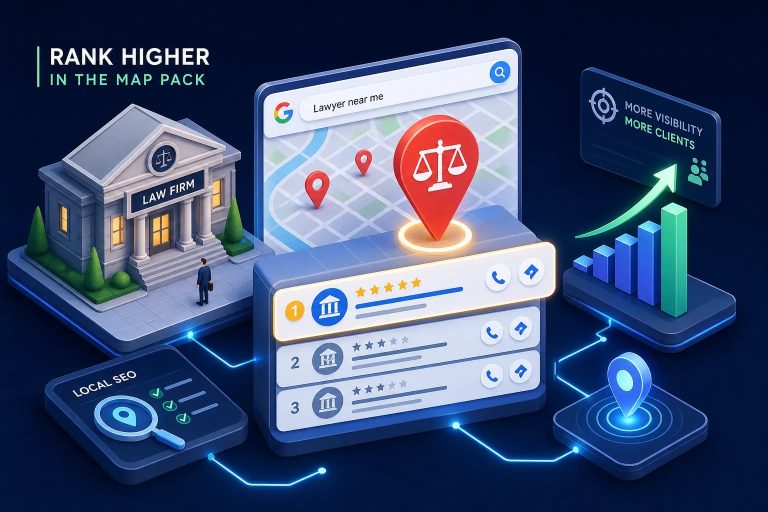
A potential client types “personal injury attorney near me” and three law firms appear before any website even loads. Those three spots get the phone calls. Everything below them gets the leftovers. Local SEO for lawyers is the process of making sure your firm owns one of those three spots instead of your competitor. This isn’t about tricks or algorithm hacking. It’s about giving Google exactly what it needs to trust your firm as the most relevant, credible option for someone searching in your city.
Four core pillars drive local rankings for law firms: your Google Business Profile, NAP consistency, legal citations, and review signals. Google also weighs prominence, the authority your firm builds through local backlinks, brand mentions, and external references, so treating that as a fifth lever is worth understanding early. Whether you’re a solo practitioner or managing a small firm, these are the levers you actually control. At Thrive Business Marketing, we work with law firms across the country on exactly this, and we consistently see firms move from invisible to the top three by applying the right work in the right order.
Why local search works differently for law firms
The three signals Google uses to rank attorneys locally
Google’s local ranking algorithm weighs three factors: relevance, proximity, and prominence. Relevance asks whether your profile matches what the person searched. Proximity measures how close your office is to the searcher. Prominence reflects how well-known and trusted your firm is across the web. Proximity is fixed. You can’t move your office, so you can stop worrying about it. Relevance is largely within your control through profile optimization and content. Prominence takes longer, it’s built through external signals like local backlinks, press mentions, and brand citations, but both are where all the meaningful optimization work happens.
Understanding this model helps you prioritize effort instead of chasing every tip you read online. Attorneys who treat local SEO for lawyers as a to-do list without a mental model tend to do a little of everything and move nothing. Attorneys who understand the three-factor framework know where to push first.
Why the Map Pack is a different game than organic rankings
Ranking in the Local Pack and ranking in organic search are related but separate disciplines. Your website’s organic SEO helps with prominence, but the Map Pack runs primarily on your Google Business Profile, review volume, and citation consistency. It doesn’t run on content volume and backlinks the way organic does. A firm with a modest website can outrank a firm with a massive blog if its local signals are stronger. That’s an important distinction, because it means you don’t need to outwrite your competitors. You need to out-signal them where local search actually counts.
Local SEO for lawyers: optimizing your Google Business Profile
Choosing the right primary category (this one matters most)
The primary category is the single highest-impact optimization a law firm can make on its Google Business Profile. “Personal Injury Attorney” beats “Law Firm.” “Family Law Attorney” beats “Lawyer.” The more specific the category, the stronger the relevance signal you send to Google. Your primary category should match your core revenue driver exactly, not the broadest possible description of what you do.
Secondary categories can cover additional practice areas, but they carry less weight than the primary. Don’t dilute your primary category by trying to cover everything. If your firm’s revenue is 70% personal injury, your primary category should be “Personal Injury Attorney,” full stop. You can layer in secondary categories for criminal defense or family law after that.
Completing services, attributes, and photos
Once the category is right, the next priority is filling out the services section with each practice area. Write concise, keyword-relevant descriptions for each service. Attributes like “free consultation” and “wheelchair accessible” reinforce completeness and trust. They’re not the primary ranking driver, but they help Google understand your firm’s fit for specific client needs and they show up in ways that can nudge a hesitant searcher to call.
Photos matter more than most attorneys expect. Real photos of your office exterior, lobby, and team consistently outperform stock imagery for engagement. When someone finds your profile and sees actual pictures of your building and attorneys, the conversion rate improves. These are the photos that turn a profile view into a phone call.
Keeping the profile active with posts and Q&A
Google treats GBP activity as a relevance signal. Firms that post updates, answer questions, and respond to reviews tend to hold stronger visibility than those who set up the profile once and never return. You don’t need to post daily. A simple monthly cadence, two posts, prompt responses to reviews, and answered Q&A entries, keeps the profile alive without becoming a second job. Treat it like a plant: it doesn’t need constant attention, but it does need regular watering.
NAP consistency and building legal citations for law firms
What NAP consistency actually means (and why it’s not optional)
NAP stands for Name, Address, and Phone. Google cross-references your firm’s contact information across dozens of websites, directories, and data aggregators. If your address reads “Suite 400” on your website but “Ste. 400” on Avvo and is missing entirely on Yelp, those inconsistencies erode the trust signal. The fix isn’t complicated, but it requires treating your NAP as a standardized identity and applying it character-for-character everywhere. One master record, applied consistently, is the goal.
The legal directories that actually move rankings
Not all citations carry the same weight. For law firms, the highest-priority sources are your state bar directory, Justia, Avvo, FindLaw, Martindale-Hubbell, Lawyers.com, and Super Lawyers. After those, broader directories like Yelp, BBB, Bing Places, and Apple Maps round out the citation footprint. Start your audit by searching your firm name and phone number directly. Check for duplicate listings before creating anything new. Duplicates split authority and confuse search engines, so they need to be resolved before you build new citations.
Why managing 200+ directories is harder than it sounds
A full citation footprint spans well over 200 directories and data aggregators, a figure drawn from standard citation audit tools, many of which pull from each other. If bad data gets into an aggregator, it can keep reappearing even after manual corrections. You correct it in one place, but an upstream aggregator repopulates the bad data a few weeks later. This is where the scope of citation management often surprises attorneys who try to handle it themselves.
Agencies that specialize in law firm SEO handle this systematically. Thrive Business Marketing manages directory listings across 200+ platforms as part of its local SEO program, so inconsistencies don’t quietly drag rankings down over months while you’re focused on running your practice.
Review signals: how to build them without begging clients
Why review quantity, quality, and recency all matter
Google doesn’t just count stars. It weighs how many reviews you have, how recent they are, and how often new ones arrive. A firm with 80 reviews collected over five years may rank lower than a competitor with 40 reviews earned in the last 12 months, an illustrative pattern that reflects how velocity signals an active, trusted practice. This is one of the most counterintuitive things attorneys learn about local SEO for lawyers: the recency of reviews matters almost as much as the volume.
Responding to every review, including negative ones, also matters. It functions as an engagement signal for Google and a reputation tool for prospective clients who read the responses before deciding who to call. A thoughtful, professional response to a one-star review can actually build trust with future clients who see it.
A practical system for asking clients for reviews
The attorneys who generate reviews consistently aren’t necessarily the ones who ask most eloquently. They’re the ones who ask systematically. That means a follow-up message at case resolution, a direct link to the Google review page, and a light reminder if the first message doesn’t land. The ask should be voluntary, non-incentivized, and open-ended. A simple message like “If you were satisfied with our representation, we’d appreciate an honest review about your experience” covers the ethical bases while still making the request clear.
Thrive’s Review Builder is designed to automate this workflow so the ask goes out at the right moment without requiring the attorney to remember to send it manually after every closed case. The system handles the timing so the review request lands when the client’s experience is fresh, not three weeks later when they’ve moved on.
What to measure and how long results take
The KPIs that tell you local SEO is actually working
Track GBP profile views, calls from the profile, direction requests, website clicks from Maps, and local pack rankings for your primary practice-area keywords. On the lead side, track inbound calls, form fills, and consultation requests tied to organic and Maps sources. Ranking movement is a leading indicator. Call volume is the lagging indicator that confirms the strategy is working. Don’t judge the effort by rankings alone in the first 90 days.
Realistic timeline expectations by market competitiveness
First measurable ranking movement typically comes within 30 to 90 days after GBP, citation, and review work is complete. Meaningful local pack traction usually shows up in the 3 to 6 month window for moderately competitive markets. In high-competition practice areas like personal injury and criminal defense, or in major metro markets, plan for 9 to 18 months before seeing consistent, durable lead volume. Firms starting from a low baseline often reach 2 to 3 times their original organic inquiry volume by the 12-month mark with consistent execution, that’s a pattern we see repeatedly, though individual results depend heavily on baseline authority and market competitiveness.
When to bring in a law firm SEO specialist
Signs the DIY approach is costing you more than an agency would
There are three clear signals that it’s time to stop handling this in-house. You’ve been working on your local SEO for lawyers for more than six months without measurable ranking movement. Your GBP, citations, and reviews are inconsistent or unmanaged across directories. Your top competitors in the Map Pack all have complete, polished profiles with strong review velocity, and you’re trying to catch up while also running a practice. When those conditions overlap, the time cost of managing this yourself and the opportunity cost of not ranking typically exceed what a specialist retainer would run.
What a reputable legal SEO agency actually delivers
A proper local SEO engagement for a law firm includes GBP management, citation cleanup across 200+ directories, a review generation system, location page optimization, and monthly reporting tied to actual lead metrics. You should be able to see where your rankings are moving, how many calls came from Maps, and what’s been done each month. If a vendor can’t show you that, the engagement isn’t structured correctly.
Thrive Business Marketing delivers exactly this for law firms across the country. The CaseFlow framework connects SEO activity to client intake outcomes, so you’re not just watching rankings move, you’re watching the connection between marketing effort and signed cases, which is the number that actually matters to a law firm. Reach out for a scope and pricing discussion to find the right fit for your market and practice size.
Start here, then stay consistent
The prioritized sequence is straightforward: fix your primary GBP category first, clean up NAP across all directories, build a systematic review generation process, and track the right metrics so you know the strategy is working. Local SEO for lawyers isn’t a one-time fix. It compounds over time, and the firms that hold the top three spots are the ones that stay consistent, adding reviews, keeping profiles updated, and maintaining citation accuracy month after month.
If you’re a solo attorney or running a small firm, you can start with the GBP steps today without any agency involved. Pick the right primary category, fill out your services, and upload real photos. That alone moves the needle for some firms. But if you’re in a competitive market and want results faster, working with a specialist who already understands how Google’s local signals interact for law firms can accelerate progress and shorten time-to-impact significantly in those early months. The local pack is where your next client starts their search. The roadmap to get there is the same whether you run it yourself or bring in help. What matters is that you actually run it.