
For years, law firms have thought about reputation management in fairly familiar terms. You wanted strong Google reviews, a professional website, accurate attorney bios, good word-of-mouth, and search results that made the firm look credible. If something negative appeared online, the goal was usually to respond appropriately, improve the surrounding content, or make sure better information was easier for potential clients to find.
All of that still matters. But AI has added a new layer to law firm reputation management, and most firms are not paying enough attention to it yet.
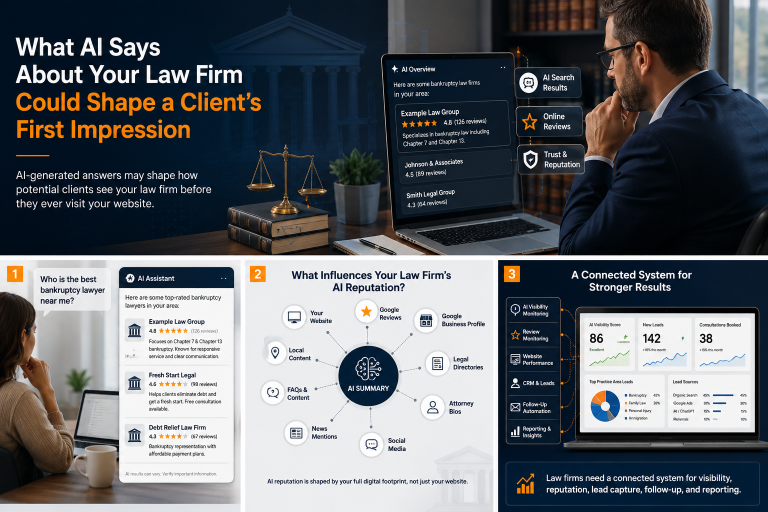
Today, a potential client may not begin by clicking through ten different law firm websites. They may ask ChatGPT, Google AI Overviews, Perplexity, Gemini, or another AI tool a question such as, “Who are the best bankruptcy lawyers near me?” or “Is this law firm reputable?” They may ask what people say about a specific attorney, how two firms compare, or what they should look for before hiring a lawyer in a specific practice area.
The answer they receive may shape their opinion of your firm before they ever visit your website, read an attorney bio, call your office, or speak with your intake team. In other words, your law firm’s first impression may no longer happen on your homepage. It may happen inside an AI-generated answer.
Why AI Reputation Matters for Law Firms
Legal marketing has always depended on trust. When someone is looking for an attorney, they are usually dealing with something stressful, expensive, emotional, or high-stakes. A bankruptcy prospect may be worried about losing their home or stopping wage garnishment. An immigration client may be concerned about family separation or deportation. A personal injury client may be dealing with medical bills, lost income, and uncertainty about the future.
That person is not casually shopping for a service. They are trying to decide who they can trust with a major life problem.
That is why online reputation matters so much for law firms. The challenge now is that AI tools do not only summarize your website. They may pull from or be influenced by many different sources across the web, including:
- Google reviews
- Google Business Profiles
- Legal directories
- Attorney bio pages
- Local news mentions
- Social media profiles
- Reddit and forum discussions
- Third-party articles
- Old website pages
- Practice area content
- FAQs and blog posts
- Public business listings
Some of that information may be accurate and helpful. Some may be outdated, incomplete, or lacking context. Some may reflect old positioning your firm has moved away from. And some may simply come from whatever information has been repeated most often online.
For law firms, that creates a real reputation risk. Not because AI is always wrong, but because AI can summarize your firm in a way that is incomplete, vague, outdated, or less persuasive than the message you would choose for yourself.

Your Website Is No Longer the Only Source of Truth
Most law firms still assume their website is the central place where prospects learn about them. That is partly true, but it is no longer the whole picture.
Your website may clearly say your firm handles Chapter 7 bankruptcy, Chapter 13 bankruptcy, debt defense, and creditor harassment. But if your Google Business Profile is incomplete, your legal directory listings are inconsistent, your attorney bios are outdated, and your reviews mention another practice area more often, AI tools may form a very different picture of what your firm actually does.
For example, a bankruptcy law firm may want to be known for helping consumers get a fresh financial start. But if most of the firm’s online footprint is thin, generic, or inconsistent, AI may describe the firm as “a local law firm that handles various legal matters.” That may not sound terrible, but it weakens the firm’s positioning. A person looking specifically for bankruptcy help is more likely to trust a firm that appears clearly focused, experienced, and visible in that area.
This is one of the reasons law firms need to think beyond traditional SEO. Rankings still matter. Your website still matters. Reviews still matter. But now your firm also needs to think about how its brand, attorneys, practice areas, reviews, content, and online mentions are being interpreted and summarized by AI-driven search tools.
The Risk Is Often Incomplete Information, Not Completely False Information
When law firms hear about AI reputation risk, they often think about AI making up completely false information. That can happen, but the more common issue is usually more subtle.
The bigger risk is partial truth.
An AI summary may describe your firm accurately in one sense, but leave out the practice area you are actively trying to grow. It may reference old content from a prior version of your website. It may pull details from outdated attorney profiles. It may summarize negative reviews without also showing how your firm responded. It may describe the firm in broad terms when you are trying to build authority in a specific niche.
This kind of partial truth can create problems because legal prospects often make fast decisions based on limited information. Someone looking for help with bankruptcy, immigration, criminal defense, estate planning, family law, or personal injury may not spend an hour researching every firm. They may glance at a summary, scan reviews, compare a few options, and decide who feels most credible.
If AI gives them a vague or incomplete version of your firm, you may lose that opportunity before your intake team ever knows the lead existed.

Reputation Management Now Includes AI Visibility
Law firm reputation management used to focus heavily on reviews, search results, and brand mentions. Those are still important, but they are no longer enough by themselves. Firms now need to understand how they appear in AI-generated answers and whether those answers reflect the way the firm wants to be positioned.
A good AI reputation review should ask questions like:
- What does AI say our firm is known for?
- Are our main practice areas described accurately?
- Do our attorneys appear credible and current?
- Are our locations, services, and consultation details correct?
- Are competitors showing up more clearly than we are?
- Are outdated or inconsistent sources influencing the answer?
- Are our strongest differentiators being mentioned?
- Does AI understand the type of clients and cases we actually want?
This is where AI visibility and reputation management start to overlap. If your firm wants to be seen as a leading bankruptcy firm, a trusted immigration firm, or a top local personal injury firm, your digital footprint needs to support that positioning across more than just your website.
Your reviews, FAQs, attorney bios, Google Business Profiles, legal directory listings, local pages, videos, and third-party credibility signals all play a role in how your firm may be understood online.
Law Firms Need Better Content Governance
Content governance may sound like a corporate term, but for law firms it comes down to something simple: someone needs to be responsible for making sure the firm’s public information is accurate, consistent, current, and aligned with the firm’s goals.
That matters because legal marketing is not just about visibility. It is also about accuracy. Law firms need to be careful with claims about experience, outcomes, specialization, awards, testimonials, and services. The content should be compelling, but it also needs to avoid misleading potential clients or creating expectations that are not appropriate.
For most firms, content governance should include a regular review of:
- Practice area descriptions
- Attorney bios
- Office locations
- Google Business Profile information
- Legal directory profiles
- Review response strategy
- Website FAQs
- Blog content
- Intake and consultation language
- Awards, memberships, and credentials
- Claims about results or experience
- AI, chatbot, and automation disclosures where appropriate
The more scattered your information becomes, the easier it is for AI tools, prospects, referral partners, and even your own team to get an inconsistent picture of the firm. Consistency matters because AI tools tend to work from patterns. If the web sends mixed signals about your firm, the AI-generated summary may be mixed as well.
How to Check What AI Says About Your Firm
You do not need to overcomplicate the first step. Start by searching your firm the way a real potential client might. Use ChatGPT, Google AI Overviews, Perplexity, Gemini, and other tools your prospects may use. Ask questions that reflect real buying intent and real concerns.
For example, a law firm might test prompts like:
- “What is [Firm Name] known for?”
- “Is [Firm Name] a good bankruptcy law firm?”
- “Who are the best bankruptcy lawyers in [City]?”
- “What do reviews say about [Attorney Name]?”
- “What should I know before hiring [Firm Name]?”
- “Does [Firm Name] handle Chapter 13 bankruptcy?”
- “Compare [Firm Name] to other [practice area] lawyers in [city].”
Save the answers and look for patterns. You are not only looking for false information. You are looking for weak positioning, missing details, outdated references, inconsistent practice area descriptions, or competitors being described more clearly than your firm.
This should not be a one-time project. AI answers can change as new content is published, reviews are added, directories update, competitors improve their content, and search engines adjust how they summarize information. For many firms, a monthly AI reputation review is a practical starting point. If your firm is entering a new market, launching a major campaign, expanding into a new practice area, or dealing with negative press, you may want to monitor more frequently.
What Kind of Content Helps AI Understand Your Law Firm?
AI tools tend to do a better job when your content is clear, specific, and well-structured. That does not mean your website should sound robotic. It means your content should answer real questions in a way that helps both people and search engines understand what your firm does.
Many law firm websites rely on broad statements such as “we fight for our clients,” “we care about results,” or “we provide experienced representation.” Those statements may be true, but they do not provide much substance. They do not explain who you help, what problems you solve, what process clients can expect, or why a specific type of client should choose your firm.
A bankruptcy law firm, for example, can build stronger visibility and reputation by answering questions such as:
- What is the difference between Chapter 7 and Chapter 13 bankruptcy?
- How long does bankruptcy take?
- Can bankruptcy stop wage garnishment?
- What happens to my house if I file bankruptcy?
- How much does it cost to hire a bankruptcy lawyer?
- Do I qualify for Chapter 7 bankruptcy?
- What should I do before meeting with a bankruptcy attorney?
This type of content helps potential clients, but it also helps AI systems understand your relevance. The same principle applies across practice areas. Immigration firms can answer detailed questions about asylum, adjustment of status, family-based petitions, deportation defense, or work permits. Personal injury firms can address accident steps, insurance questions, deadlines, damages, and settlement concerns. Family law firms can answer questions about custody, divorce, support, mediation, and property division.
The more clearly your firm explains what it does, who it helps, and how clients should think about their situation, the easier it becomes for AI-driven systems to connect your firm with relevant searches.
Reviews Still Matter, But They Need Context
Reviews remain one of the strongest trust signals for law firms. Potential clients read them, Google uses them, and AI tools may summarize them. But reviews alone do not always tell the full story.
A firm may have strong reviews but weak website content. Another firm may have helpful content but inconsistent review management. A firm may have many reviews for one practice area while trying to grow a different one. In each case, the overall digital footprint may send mixed signals.
The goal is alignment. Your reviews, website, Google Business Profile, legal directory profiles, attorney bios, and content strategy should reinforce the same core message. If you want more bankruptcy cases, your digital footprint should make that focus obvious. If you want more immigration consultations, your reviews and content should support that positioning. If you want higher-value family law or injury cases, your content should reflect the specific concerns and case types you want to attract.
A strong reputation strategy is not only about getting more reviews. It is about making sure the full public picture of the firm supports the kind of work you actually want more of.
Where CaseFlow Fits In
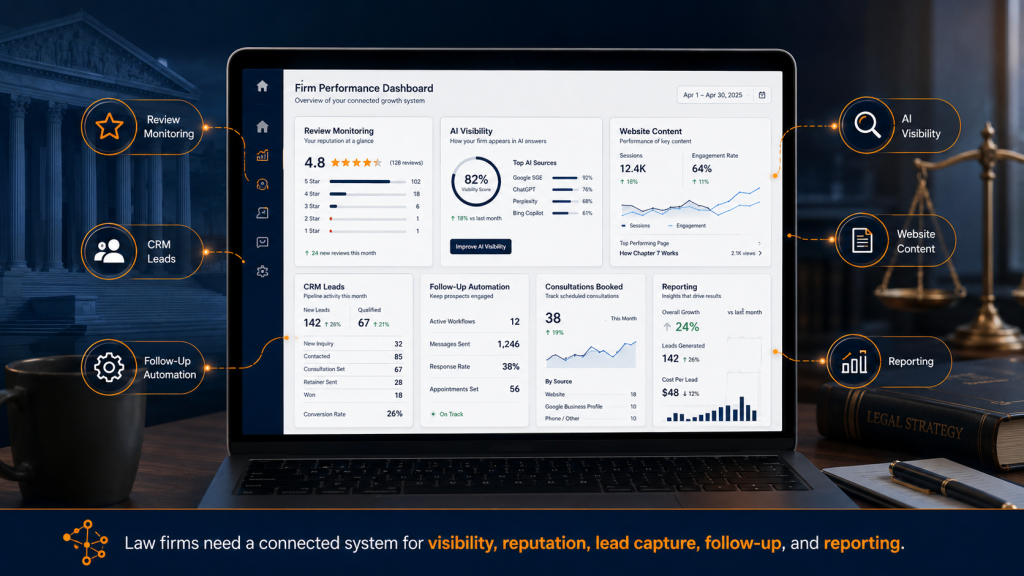
This is one of the reasons Thrive built CaseFlow for law firms. Most firms do not need random marketing activity. They need a connected growth system that brings visibility, website conversion, lead capture, CRM tracking, follow-up automation, and reporting together.
AI reputation and AI visibility are now part of that larger system. It is not enough to simply show up online. Your firm needs to show up accurately, consistently, and persuasively across the places where potential clients are making decisions.
CaseFlow helps law firms connect the core pieces of that system, including website management, SEO and AI search optimization, paid ad management, lead capture, Surge CRM setup, pipelines, automations, custom forms, follow-up workflows, and reporting. The goal is not just more traffic. The goal is to help the right potential clients find your firm, trust your firm, contact your firm, and move through the intake process with fewer gaps.
For law firms, that distinction matters. A lead generation campaign is only valuable if the firm can capture the opportunity, follow up quickly, track what happened, and understand which efforts are actually turning into consultations and signed clients.
The Firms That Adapt Early Will Have an Advantage
AI is not replacing law firm marketing, but it is changing how potential clients form opinions. Your next client may still find you through Google, read your reviews, visit your website, watch one of your videos, or ask a friend for a referral. But increasingly, they may also ask AI to summarize their options.
That means your firm’s reputation is no longer shaped only by what you publish on your own website. It is shaped by what AI can find, understand, summarize, and repeat.
The firms that take this seriously now will have an advantage. They will build clearer content, stronger reviews, better profiles, more consistent messaging, and a better understanding of how prospects see them online. Firms that ignore it may find that their reputation is being shaped by outdated pages, incomplete listings, random summaries, competitor content, or whatever AI happens to surface first.
For law firms, trust is everything. In the AI search era, protecting that trust starts before the client ever lands on your website.